
This piece was written during the 2023 WGA and SAG-AFTRA strikes. Without the labor of the writers and actors currently on strike, the movie being covered here wouldn’t exist.
This review contains some spoilers for Oppenheimer.
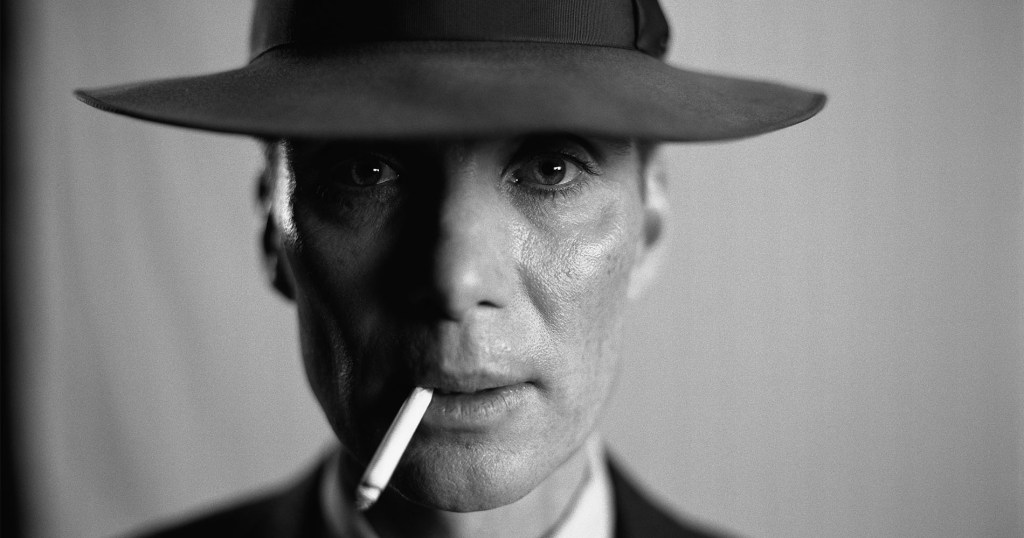
“How could this man who saw so much be so blind?” Lewis Strauss (Robert Downey Jr.) ponders in Christopher Nolan’s newest film Oppenheimer. While Oppenheimer was the scientist behind the bomb, Strauss was a businessman involved in early nuclear power and the chairman of the US Atomic Energy Commission. The three-hour epic is a study not only of how the titular genius J. Robert Oppenheimer (Cillian Murphy) created the atomic bomb but also of the fallout of its creation within his own life.
Oppenheimer is Nolan’s most character-driven work and also his most simple to understand despite the complicated science and sometimes confusing non-chronological framing. It takes us through Oppenheimer’s early career as a professor and his time leading the creation of the bomb at Los Alamos. In parallel storylines, we also see Oppenheimer’s security clearance hearing a decade later, in which his Communist associations are used to edge him out of the nuclear energy conversation, and Strauss’s Cabinet position confirmation hearing, which became a public battlefield for both Strauss and Oppenheimer’s reputations.
If that seems like a lot for one movie to handle, that’s because it is. It’s sometimes difficult to put the full story together from the order in which it’s being told, particularly if you’re not already familiar with Oppenheimer’s story. For those who don’t know, Oppenheimer is best known as the scientist who was head of the Manhattan Project, which created the atomic bomb at the Los Alamos laboratories in New Mexico during World War II. While the bomb was eventually dropped on Hiroshima and Nagasaki, the film is a good reminder that it was originally developed out of fear that the Nazis would develop one first.
However, the atomic bomb was no ordinary invention. It took a team of brilliant scientists, but not everyone in the scientific community agreed with unleashing such power into the hands of governments. As Niels Bohr (Kenneth Branagh) says in the movie, “This isn’t a new weapon; it’s a new world.” Bohr would know, as he was the Danish physicist who won the Nobel Prize for breakthroughs in understanding atomic structure and quantum theory. Nolan does a commendable job of reckoning with what creating such a destructive weapon meant without ever showing its victims, but rather focusing on the psychological effects upon its creators and the way that it opened up a plethora of new issues around the government’s collaboration with scientists.
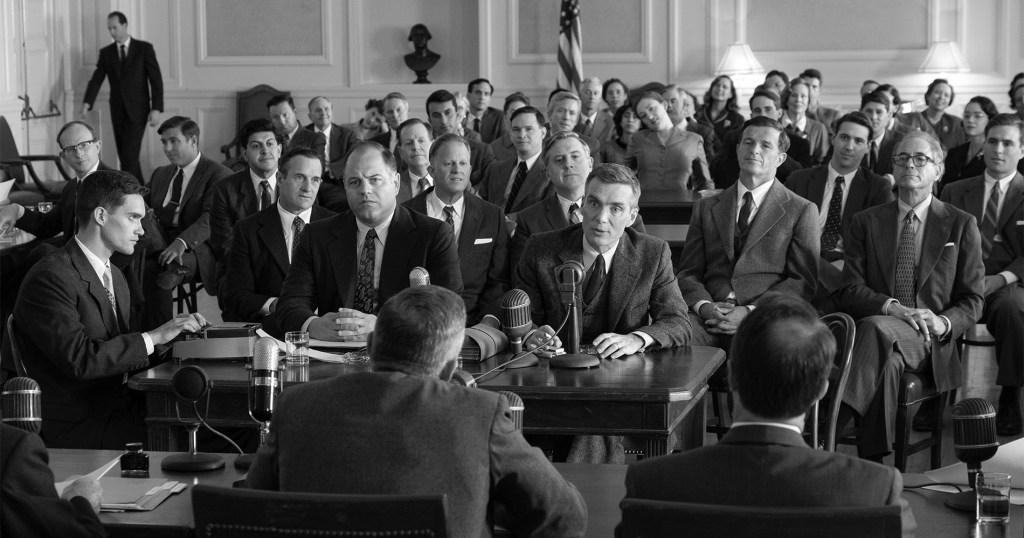
The film also shows how the Red Scare ruined the careers of scientists (along with actors, politicians, and people in just about every profession), many of whom had been linked to the American Communist Party in the years leading up to World War II. Oppenheimer himself had many ties – family, friends, and colleagues – to the party and refused to keep his politics entirely outside of academia while he was a university professor. During the war and through the 1950s, the government used it against him, boxing him out of some things while also dangling their knowledge of his association with Communism over his head as a threat.
With a mammoth cast like Oppenheimer’s, in which many actors only have a few minutes of screen time, it’s inevitable that most of the cast does not have the opportunity to give a great performance. But there are many standouts in the cast, from Matt Damon as the antagonistic but ultimately supportive General Groves to Benny Safdie as the intelligent but disagreeable Edward Teller. Alden Ehrenreich plays a Senate aide working for Strauss during his hearing and gets several little moments of humor that provide levity. His character is also one of the few morally uncomplicated figures in the film, giving the audience someone with whom they can fully align themselves as he also finds out the truth about Strauss’s relationship with Oppenheimer over the course of the film.
But there are two truly Oscar-nomination-worthy performances in the film. Robert Downey Jr. finally has the role that many of us have been waiting years to see him to play, a seeming return to his earlier work as a serious actor before he became a king of the Marvel franchise. It’s a vibrant reminder of his abilities as an actor as he expertly keeps the audience guessing what his character’s true motivations are.

Meanwhile, Murphy’s turn as Oppenheimer holds the film together. Any character study is only as good as the actor playing its subject, and Murphy was more than up for the task, showing Oppenheimer’s anxiety and stress in his physicality through the way he holds his shoulders to the haunted look in his unsettlingly blue eyes.
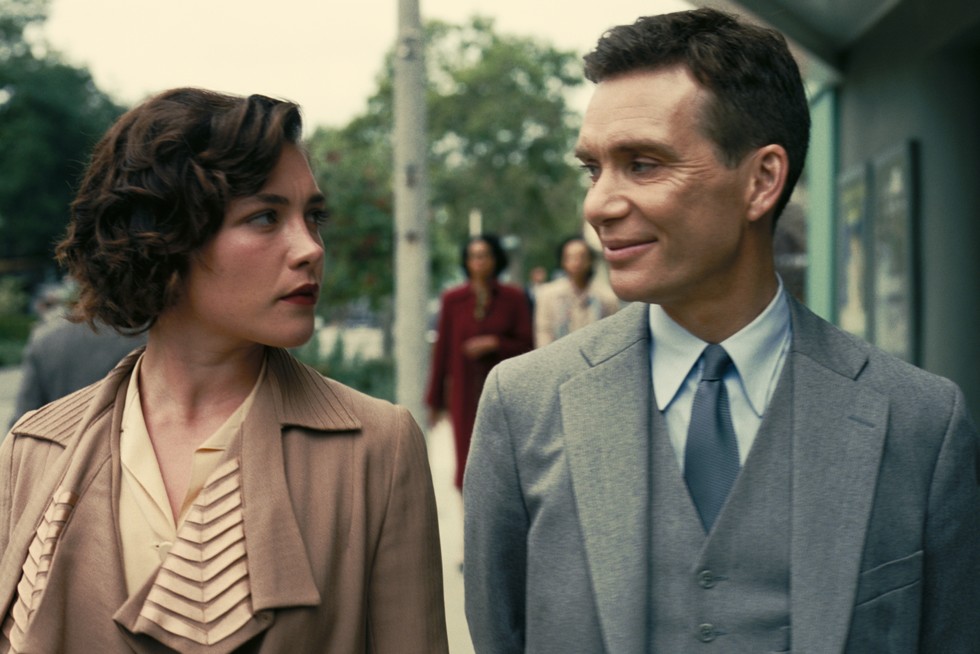
Unfortunately, though Oppenheimer represents a step up for Nolan from some of the issues that had previously plagued his films, he still cannot write a well-rounded female character. We see three main women that knew Oppenheimer: his friend Ruth Tolman (Louise Lombard), his wife Kitty Oppenheimer (Emily Blunt), and his lover Jean Tatlock (Florence Pugh). All women make the most of their short screen time, particularly Blunt and Pugh, but none are allowed the chance to be a fully-rounded character as much as the male characters are.
Blunt’s Kitty fares somewhat better, despite being reduced to her complete disinterest in being a mother and her drinking problems. Her character arc doesn’t naturally lead to the strong scene that she has in the later part of the movie, but it’s still an excellent chance for Blunt to show off her acting abilities.
If Kitty Oppenheimer isn’t presented in her full complexity, then Jean Tatlock fares even worse. Tatlock was arguably almost as interesting as Oppenheimer himself, having struggled with her sexuality from her teen years onward and earning a medical degree after plans of becoming an actress failed. While the initial sex scene between Oppenheimer and Jean is handled well, demonstrating how their relationship is rooted in an intellectual connection, Pugh is nude for seemingly half of the rest of her screen time in the film, as well. Much of it feels completely unnecessary, particularly when paired with how little development the character is given.
Furthermore, Nolan presents Jean’s suicide as something that makes Oppenheimer feel guilty – he couldn’t be there for her while he was working on the Manhattan Project because of her ties to Communism (not to mention his marriage to Kitty). In reality, Jean’s death was the result of a lifelong struggle with depression and other mental health issues. In the suicide note found by her father, Jean wrote, “I think I would have been a liability all my life—at least I could take away the burden of a paralyzed soul from a fighting world.”
The film also has a handful of other issues that keep it from being a true masterpiece in my eyes. It gets too intense too quickly, not leaving much room for it to build over its three-hour runtime. From the in-your-face cinematography to the demanding score by Ludwig Göransson, it feels like it reaches what should be the climax for your senses within the first hour. This makes the viewing a somewhat exhausting experience despite the truly phenomenal craftwork and acting being showcased.
And the design is truly splendid, from the 1940s and 1950s costuming to the production design, recreating everything from the town of Los Alamos to the Oval Office of the White House. The sound and lighting work in Oppenheimer’s celebratory speech after the use of the atomic bomb is easily the best of the year; it perfectly demonstrates his inner turmoil as he already begins to question the morality of the weapon he has created.
Oppenheimer’s story is a complicated one, and I’m still not entirely certain that Nolan was the best person to tell it. Though still fettered by some of his usual issues, he creates what is almost certainly his best work in Oppenheimer. It’s a complex exploration of the creation of the worst weapon that has ever existed and the scientist who made it, making the audience ponder questions of science, politics, war, and love.



 Culture Cabinet
Leave a comment