

This piece was written during the 2023 WGA and SAG-AFTRA strikes. Without the labor of the writers and actors currently on strike, the movie being covered here wouldn’t exist.
Barbie never asked for any of this.
The humble fashion doll created by Ruth Handler in the late 1950s was made and marketed as a “Teenage Fashion Model” in response to the children’s dolls of the time, which were only baby dolls. Her shoulders were so slim they could barely hold the expectations of one child, let alone the weight of the entire history of feminism. Barbie was never meant to stand in for all women, and yet seemingly everyone has very strong feelings about Barbie and what she means to girls, to women, to the culture at large: Barbie sets beauty standards too high! Barbie is empowering! Barbie promotes a shallow, consumerist lifestyle! Barbie wasn’t built to bear the brunt of both sides of the ongoing culture wars, but that’s what happened. She’s just an “adult-bodied” doll for children to have fun dressing up in different outfits. Something to be played with and enjoyed. Perhaps – as more career-focused versions of Barbie were introduced – even something to be inspired by. But children have minds of their own. They will take their emotions out on a doll, twisting and tearing her every which way, haphazardly cutting her hair and drawing on makeup. They will overly identify with a doll, turning her into an avatar of all their own hopes and fears, granting her emotions that an inanimate object doesn’t have. And that’s just children. When adults get involved? Forget it.
Greta Gerwig is keenly aware of all of this, as the cheeky opening of her Barbie film makes clear. In a pitch-perfect parody of Stanley Kubrick’s 2001: A Space Odyssey, we see young girls half-heartedly playing with their baby dolls until they spot a monolith: Barbie (Margot Robbie), in the iconic black and white striped bathing suit she was first sold with. Helen Mirren’s spot-on narration tells us what a cataclysmic event this was: after generations of girls who could only play with dolls that allowed them to pretend at being mothers, here was a doll that allowed them to pretend at being anything, thus freeing them from the tyranny of the patriarchy and ending sexism forever. “Or at least,” Mirren continues as the audience knowingly chuckles at the dramatic irony, “that’s what the Barbies think.”
It’s immediately clear from this scene what Gerwig wants to do with this film, at least in part: Rescue Barbie from the culture wars and reclaim her status as an icon, if not of feminism, then of femininity. No one woman can end sexism, and much less can any one woman be everything to everybody. So why should anyone expect a doll, who has no agency or free will of their own, to do so? In doing this, Gerwig manages to get at the big questions at the very heart of human existence: What is our purpose? How do we deal with the ever-present threat of death? Why do men run the world? That she manages to do this while also making one of the funniest, airiest, sunshiniest cinematic confections of the year – which also happens to be a big shiny piece of corporate product placement on top of all that – is nothing short of a miracle.
Gerwig’s Barbie is the platonic ideal of a Summer blockbuster – yes, it’s a big, synthetic piece of feel-good fluff designed to sell a whole range of products (toys chief among them), but it’s also a clearly personal artistic statement about not just the world we live in, but how Barbie the doll fits into that world. Almost literally: after the unthinkable happens to Barbie (her heels fall to touch the ground), she is sent on a quest to the real world in order to find the human playing with her and try to fix it. (Don’t question the metaphysics of the whole Barbieland-Real World continuum, they don’t really make sense and aren’t really important to the story.)

Once arriving in the Real World with Ken (Ryan Gosling), who Mirren helpfully tells us only has a good day when Barbie looks at him (as opposed to Barbie, who always has the best day ever regardless of Ken’s presence), the dolls find that it’s not at all what they expected. For one thing, everybody keeps staring at them – both of them, Ken is quick to point out, although only Barbie detects a “hint of violence” in those stares. But for another, more important thing, Barbie and Ken quickly learn that the ideals the Barbies believe they have imparted to girls in the real world have all been for nought. When Barbie does find Sasha (Ariana Greenblatt), the girl she sees in her visions of someone playing with her, Sasha tells her that Barbie has set the cause of feminism back years with her unrealistic beauty standards and vapid consumerist ideals. Ken, meanwhile, learns that in the Real World, it’s not the girls who have the dream houses and dream cars all to themselves, but the men. People look up to him here, even seemingly need him here in ways that Barbie never has. Armed with this knowledge (and some books from a school library), Ken brings the patriarchy back with him to Barbieland, and this is where things start to get really interesting.
Barbie has been a cultural mainstay for so long that it’s easy to forget about the Ken of it all. He made his debut in 1961, two years after Barbie, and instead of brushable hair like Barbie, he had a piece of felt that was replaced the next year with molded plastic. Ken may have been a doll with his own backstory and personality, but in conception he was always more of an accessory for Barbie; he literally only exists so that teenaged Barbie could have a boyfriend. Gerwig’s genius script (co-written with long-term partner Noah Baumbach) takes this to hilarious extremes. When Ken suggests that he sleep over at Barbie’s Dream House and Barbie confusedly asks why, he confesses that he’s not really sure.
Upon learning that men rule the Real World, Ken feels empowered to take power back in Barbieland. We don’t see this happen, but it’s not hard to figure it out, since we see this sort of thing play out on a regular basis every day. What we do see is what happens to Barbieland after Ken’s Patriarchy push, and the film is absolutely merciless in its skewering of men and their tiny, fragile egos. It doesn’t matter if you’re a film bro, a “sensitive” guitar player, or just a guy who likes his gal to bring him a nice cold brewski from the mini-fridge whenever he runs out, this film will come for your throat. The thing is, though, Ryan Gosling is so committed to the bit as Ken that you will laugh with him instead of at him.

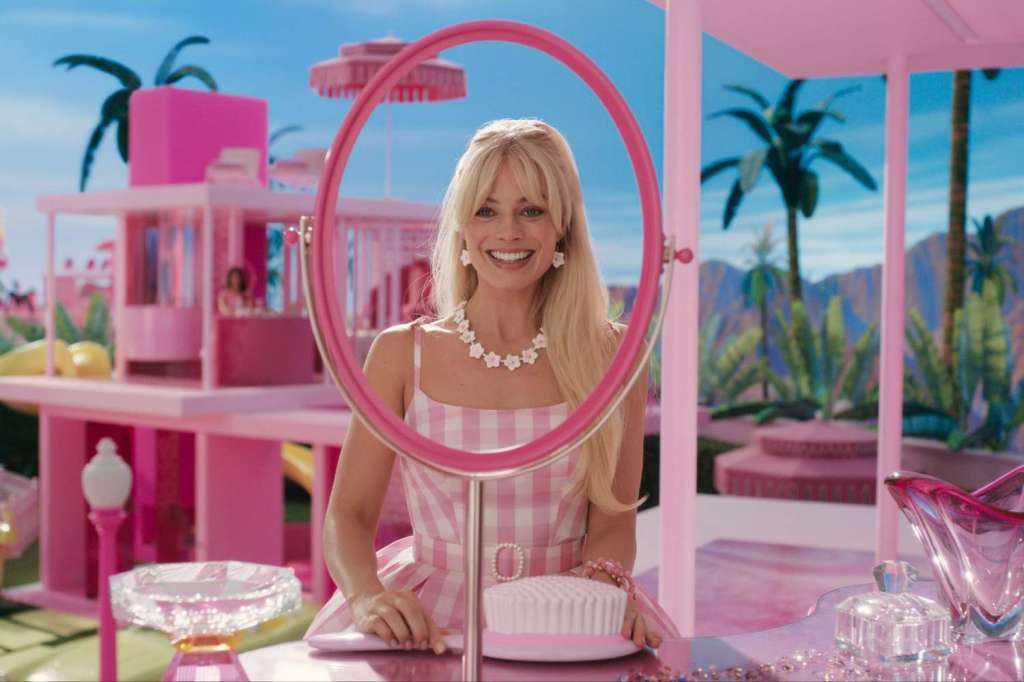
And OH, how much you will laugh. Gosling’s Ken is one of the most hilarious comic creations in recent memory. It’s not just the dialogue, carved by Gerwig and Baumbach to a sharp point (the scene where Ken, having just learned about the patriarchy, goes to a Real World hospital and expects to immediately become a doctor is a savage dissection of male entitlement, as is the hilarious bit about “The Godfather”, even if it’s an old joke), but Gosling’s performance. Both he and Margot Robbie have taken cues from the patently plastic aesthetic of the Barbieland sets (brainchild of the genius production designer Sarah Greenwood) and exploit it to different ends. While Robbie peels back the layers to get at the core of what makes her “Stereotypical Barbie” tick, Gosling adds layers on top to hide the big gaping hole at the center of Ken’s existence, the deep dark secret that he needs Barbie more than anything. Watching Robbie peel back those layers is remarkably affecting, as the actress uses her wide open face to portray pure confusion and loss in a way that we’ve never seen before. But each successive layer that Gosling adds to his Ken is even more hilarious than the last, culminating in a glorious dance battle to one of the film’s many hysterically catchy original songs, “I’m Just Ken”.
Unfortunately, the care and nuance Gerwig has given to Barbie and Ken aren’t as present with the film’s human characters, Sasha and her mother Gloria (America Ferrera). Gloria is a Mattel employee who has been having a hard time balancing her work with being a working mom, and Gerwig and Baumbach have given her a truly incredible monologue in which she lays bare to Barbie all the contradictions of modern womanhood and why it’s so difficult to be a woman. It’s the screenplay’s shining moment, the scene that is destined to be clipped and memed to death and will ultimately become the one thing above all others that the film is remembered for. It’s an incredibly moving moment, and Ferrera plays it beautifully. But the character development for Gloria and especially Sasha isn’t plotted out very well. Instead of a character arc that smoothly gets them from one place to another, their story feels more like a leap of faith, where a character suddenly makes a decision that makes sense narratively but feels unearned on a character level.
This is the only place where the screenplay really falls into the trap of mainstream commercial cinema’s flat characters and prescribed emotional beats, though. Everywhere else, Barbie is a marvel of clever concept and witty execution. Barbie wakes up every day to a Lizzo song, and it takes a whole scene and part of a follow-up to even realize that the song is not only narrating Barbie’s life but narrating what is specifically happening to her at every moment. The lyrics are funny enough talking about how her mirror isn’t really a mirror or how she can’t really eat or drink anything, but the song’s reprise takes it to a whole other level. Barbie and Ken’s journey to the Real World involves them taking a car, a boat, a camper van, a tandem bike and a rocket ship before getting to the real world on roller blades, and each stage of that journey is lovingly detailed in tactile, brightly-colored production design that brings past Barbie products to thrilling life. The attention to detail throughout is mind-boggling. The Barbieland set is insanely detailed, with some neat piece of design filling every corner of the frame, and nearly every outfit any of the film’s many Barbies and Kens – and lone Alan (Michael Cera) and Midge (Emerald Fennell) – wear is based on an actual Barbie outfit, and some of them get very funny call-outs.
But unlike this year’s Super Mario Bros. movie, which substituted video game references for actually funny jokes wherever it could, Barbie isn’t just references to dolls and other Mattel toys. The film’s concept is clever, and its humor is as pointed as it is funny, making for a film that feels weighty even as it floats through its nearly two hour runtime like a helium balloon. Against all odds, Gerwig has somehow managed to have her cake and eat it with this film; Barbie is as brightly-colored a crowd-pleaser as any corporation trying to sell merchandise could want while still having something to say about the world.
Clearly, many people don’t like what Gerwig has to say about the world, which is proof positive that you can’t please everybody. But in more ways than one, those people who didn’t like what she was saying have proven Gerwig’s point. Just like every woman on the planet, Barbie cannot be everything to everyone, but she’s a doll, not a human being. No film can please everyone (and this film makes an incredibly valiant, largely successful effort to do so), but every film has something to teach us, and so does Barbie: Girls can be whatever they want to be, but the flip side of that is that men can too. In a world where men have been in control for centuries on end, it’s even more difficult for girls to be whatever they want. This is because absolute power corrupts absolutely, and no one who wields it is immune. No one should control anyone else, but we can control ourselves, and if we focus on the power we have over ourselves, that’s when we can reach our full potential and can truly be whatever we want to be. Because yes: We are each Kenough.



 Culture Cabinet
Leave a comment