
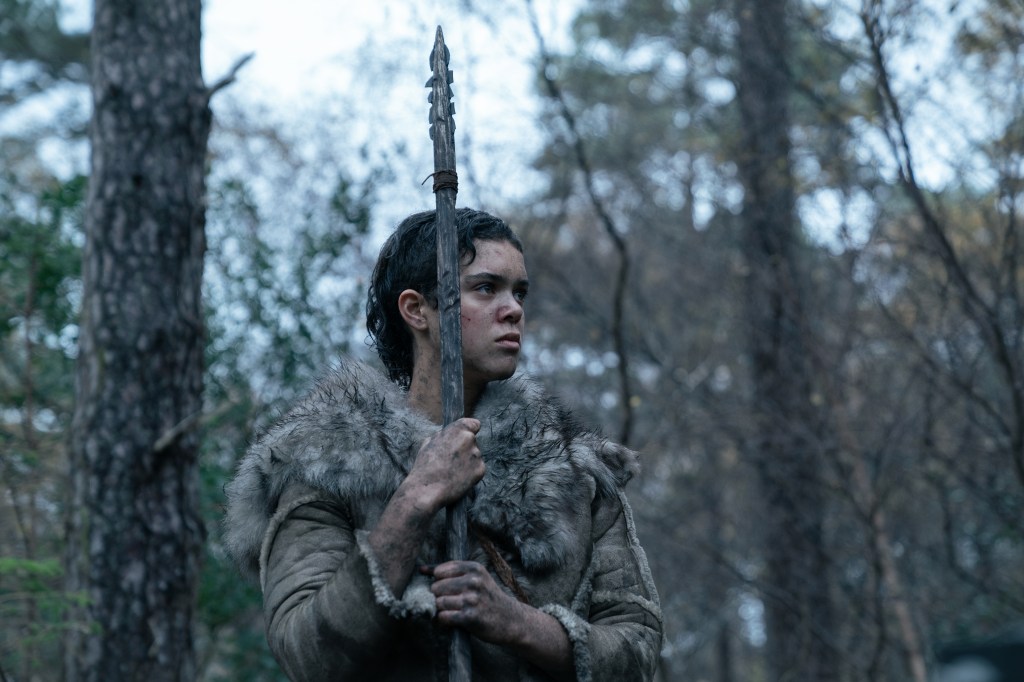
It’s ambitious to set your first feature film 45,000 years in the past, with an original language and a world completely unfamiliar to the modern viewer. Yet, Scottish director Andrew Cumming manages to pull off this impressive feat with Out of Darkness. The thriller follows a group of six prehistoric people as they try to make a life for themselves in a new land and are met with severe challenges.
The group’s leader Adem (Chuku Modu) has broken away from the rest of their tribe after their land became barren and their hunting grounds empty. But they arrive to find the rugged landscape equally barren and windswept. Most worryingly, they’re not alone and the threat of what lurks in the darkness begins to chip away at them mentally as they try to forge a new life.
Adem is accompanied by his pregnant mate Ave (Iola Evans), his younger brother Geirr (Kit Young), his son and heir Heron (Luna Mwezi), and their elderly advisor Odal (Arno Lüning). Also with them, but less secure in her place in the group, is the “stray” Beyah (Safia Oakley-Green), who is an outsider newly adopted into their small society.
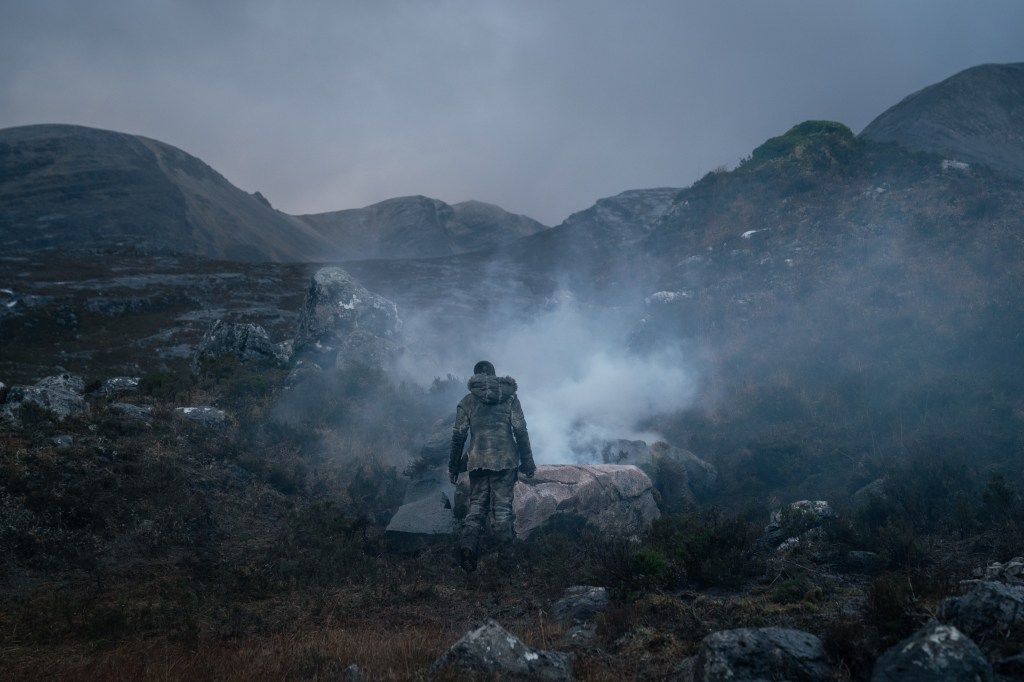
Ruth Greenberg’s script excellently builds the relationships between the characters, without much backstory. Despite the film taking place so long ago that it’s nearly unfathomable, many of the struggles that the characters face are relatable. Ave fears that she or her child may not survive the pregnancy, or that the child will be a girl who will have to work hard to prove her place in the group. Adem is obsessed with protecting the safety of his heir, Heron, but overly confident in his ability to provide for the group. Geirr is torn between his attraction to Beyah and his loyalty to his brother.
The world-building is very effective, particularly the invented language which the creative team calls “Tola.” The characters speak only this language throughout the movie, with English subtitles. Dr. Daniel Andersson, a historian and multi-linguist, made the language, which is a mix of Arabic and Basque roots and vocabulary. The care taken in the language’s creation certainly shows, and the actors make it seem completely natural. It certainly adds to the feeling of this taking place in a foreign world.
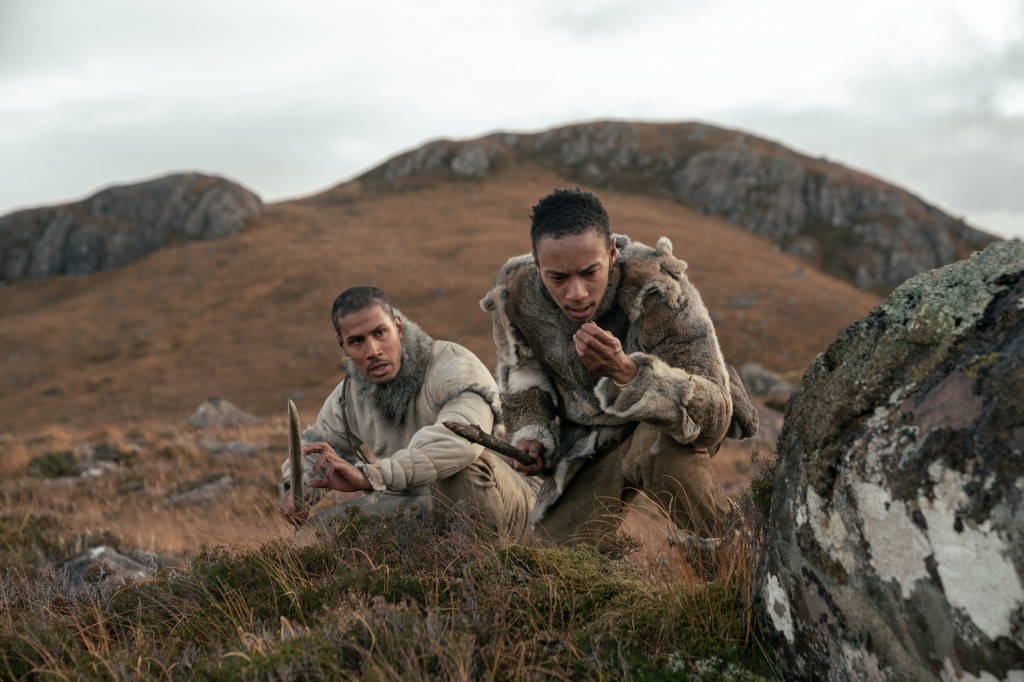
The film takes place in the Highlands of Scotland, which was also where filming took place. The isolation of the land lent itself well to the characters’ experience and to being able to film during the COVID lockdown. The cinematography, particularly in how it portrays the harsh but beautiful landscapes, is gorgeous.
Dr. Rob Dinnis, a Paleolithic archeologist, also consulted on the film. As a historian myself, I was impressed by the team’s dedication to attempting historical accuracy for a time period about which we know so little. Michael O’Connor’s costume design doesn’t fall into the trap that so many historic films do of looking overly modern or trendy.
The tensions within the group and between them and their new environment are beautifully reflected in the crafts of the movie from Adam Janota Bzowski’s anxiety-inducing score to the sound work, emphasizing the wind and the noises of the wilderness. Perhaps most effective is the use of firelight in nighttime scenes to create suspense by subtly reminding the audience of how little we know of what’s in the darkness.

While the end of the film is not as great as the beginning, the actors’ performances manage to keep the audience onboard. From Lüning’s feral turn on the women of the group to Young’s tear-filled eyes as he reacts to the breakdown of the group dynamics, each person creates a nuanced character without much dialogue. As it hurtles to its conclusion, the film shifts to center on the character of Beyah, with Oakley-Green portraying her fierce determination to survive and her vulnerability as a woman within this society.
The overall message of the movie is that it’s hatred and fear that are the greatest threats to us, not anything else that lurks in the dark. For a film set 45,000 years ago, the lessons are all too relevant for today: that when we seek to destroy those different from us instead of understanding them, we risk our own livelihood as well.
Out of Darkness is an unconventional survival thriller, but one that has much to offer between its conception of a Paleolithic world, the compelling performances, and the unique craftwork.



 Culture Cabinet
Leave a comment