

*This review contains spoilers for Hoard.*
Occasionally you stumble across a film that can’t exactly be summarized after one viewing. It needs some time for digestion at a minimum, if not a second viewing to allow the viewer time to actually process.
With time for both, I still find myself struggling to come to grips with exactly how I feel about Hoard. Though, the more I sit on it, the more I think that may actually be a good thing.
Hoard is the feature film debut of director and screenwriter Luna Carmoon, and follows the story of a young girl, Maria (Lily-Beau Leach), who lives with her mother, Cynthia (Hayley Squires), who suffers from a hoarding problem. Maria clearly loves her mother very much, but struggles with the effects of her mother’s lifestyle, from bullying she receives at school to the occasional tension she shares with her mother.

When her mother unexpectedly dies in an accident, Maria is left feeling lost and guilty for her mother’s death, a feeling that we see has carried on through to an adult Maria (now played by Saura Lightfoot Leon).
Now living with her foster mother, Michelle (Samantha Spiro), Maria meets Michael (Joseph Quinn), one of Michelle’s former foster children, who is now facing impending parenthood himself. Michael takes to a fascination with Maria, matching her frantic energy and enabling her errancy.
As their relationship develops, flashes of moments shared with her mother start to infiltrate Maria’s mind, and she has a harder time distinguishing what’s reality and what’s simply a flashback of her childhood that she’s projecting onto Michael. The result is a tense third act that suggest that the aftermath of Maria’s unstable childhood go beyond the hoarding.
At its core, Hoard is a demonstration in mastering of craft in every facet. The screenplay is original and eccentric, and the direction that moves at a clipping pace. The film plays out at a steady pace, establishing the importance of Maria and Cynthia’s relationship, and the impact that the traumatic circumstances in which Maria lost her mother have on her.
But, once Michael enters the picture, the film picks up and moves at a much more sporadic pace, signifying the way that his presence is causing Maria to spiral all the more. There are some scenes that feel like a bit of a roller coaster, as Maria and Michael engage in increasingly more chaotic activities – including eating human ashes out of a cereal bowl and Maria asking Michael to hold a hot iron to her stomach.
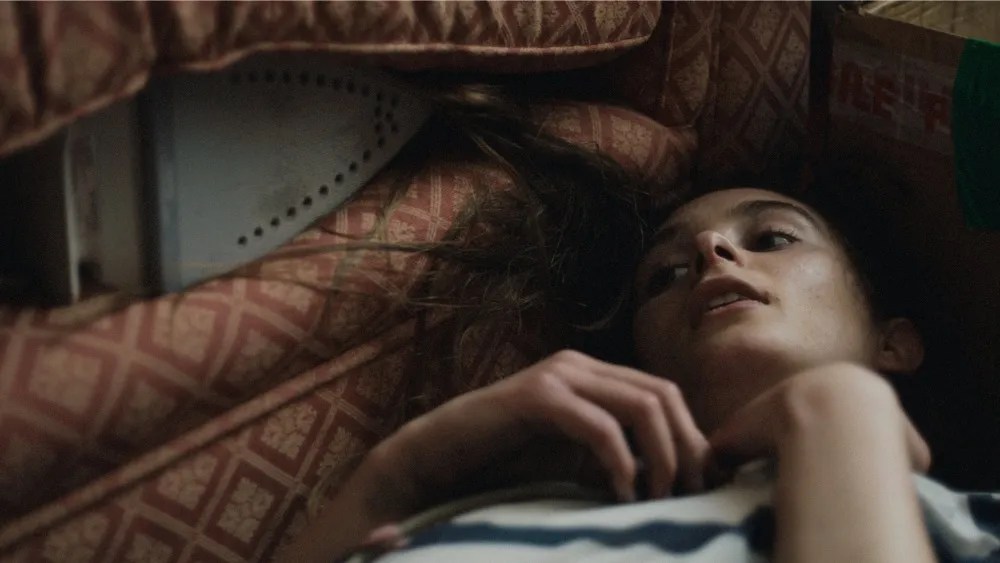
Such an intense screenplay would only translate to screen effectively with actors who are willing to sell it. Thankfully, this film does not lack for such. Saura Lightfoot Leon gives a brilliant feature film debut as Maria, approaching her character with the unhinged chaos that’s required, while still leaving undertones of compassionate humanity. It is clear that Maria acts the way she does because of the traumatic circumstances that she incurred as a child. It does not seek to excuse her actions, nor shame her, but to simply show a human perspective on her unresolved trauma.
Joseph Quinn is also giving a standout performance, in an immense departure from his breakout role as Stranger Things’s Eddie Munson, but feeling in-line with his pre-Stranger Things performances. Quinn is not afraid to pull out all the stops and surrender to the chaos of his own character, that at times matches Maria’s. There’s a level of desperation to his character that borders on being pathetic, yet the viewer can’t help but feel for him, as it’s made clear that he, like Maria, is simply a product of circumstances. While Quinn’s upcoming film credits are all but certainly going to turn him into a bona fide star (if he’s not already), his performance in Hoard is a testament to how deserved that success is.
Hoard is the kind of film that may leave the viewer reeling but in the best way. The performances alone make it worth the watch, and the lightning pace at which it moves will keep the viewer hooked from the get go.
We viewed this film as part of the Santa Barbara International Film Festival.




 Culture Cabinet
Leave a comment