
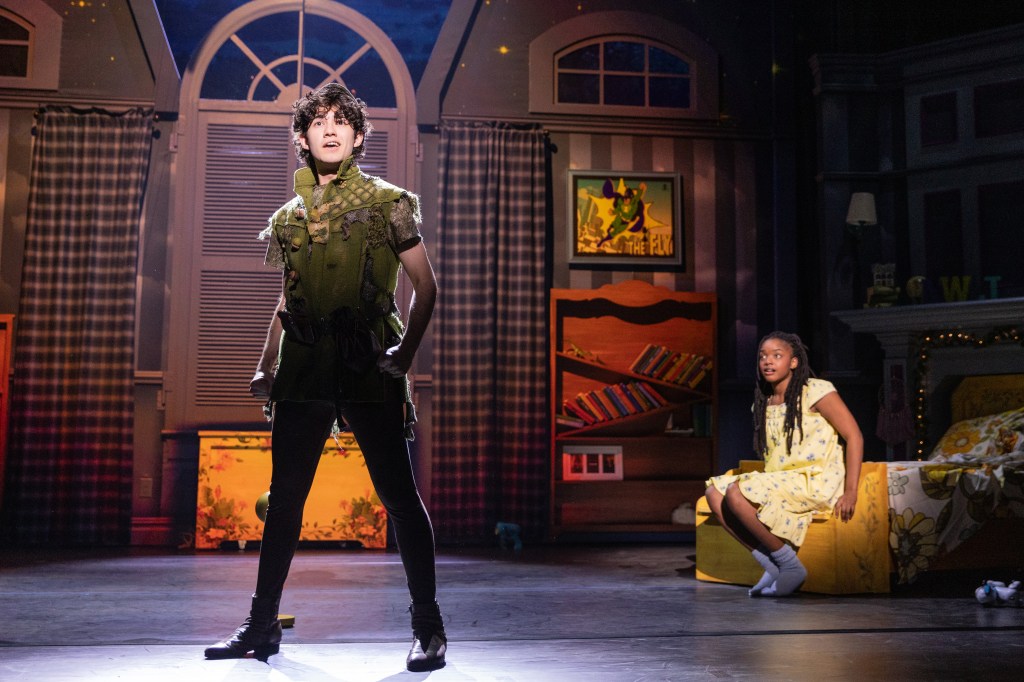
From the moment that the new national tour of Peter Pan started, with an announcement acknowledging the indigenous tribes who once lived on the land on which the Durham Performing Arts Center sits, I knew it was going to be a new experience of the beloved classic. This new production is unique in many ways: it breaks from the tradition of having a female actress play the role of Peter, it’s set in the modern United States instead of Victorian England, and Indigenous writer Larissa Fasthorse has largely rewritten the book. But despite all of these changes, it’s still the story of a boy who refuses to grow up and who introduces the Darling children to a magical world called Neverland.
Peter Pan was originally the brainchild of J. M. Barrie, whose play premiered in 1904, followed by a 1911 novelization. In 1954, a new adaptation premiered on Broadway, with Mary Martin in the role of Peter. The music by Moose Charlap and lyrics by Carolyn Leigh became well-known throughout the country, as NBC broadcasted it on television in 1955, 1956, and 1960. It’s often been staged in the seventy years since its inception, but this new tour breathes new life into it and corrects some wrongs that have existed within the story for over a century.
For those unfamiliar with it, Peter Pan is the story of the Darling children: eldest daughter Wendy, studious John, and precocious Michael. While their parents are out at a party one evening, the titular Peter sneaks into their nursery to find his shadow, which had become detached as he’d hovered near their nursery window to hear the stories their mother told them.

Peter and the fairy Tinker Bell introduce the kids to the concept of Neverland, a magical land of pirates, mermaids, and fairies, where Peter leads a crew of Lost Boys who never grow up. But when they accompany Peter there with the help of some fairy dust, they’re met with danger from the dastardly Captain Hook and Tiger Lily and her tribe of Indians.
This version modernizes the story, which works best when they don’t try to force it. The modern setting largely doesn’t change much (so much so that it feels simply like it’s cheating us out of a Victorian nursery set), but bits like Wendy trying to make a dancing video to go viral online so that she can pay for medical school feel forced. There’s also the issue that the original music, with classic songs like “I Gotta Crow” and “I Won’t Grow Up,” seems at odds with contemporary Gen Alpha children.
Naturally, a production of Peter Pan is only as good as its Peter, and Nolan Almeida does a commendable job in the role. While it’s a bit jarring to see a young man in the role onstage, rather than a woman, he nails the youthful mischievous spirit that defines Peter. Hawa Kamara is perfectly his equal as Wendy, her take-charge attitude delightfully contrasting with her desire for Peter’s affection. Raye Zaragoza is a spunky Tiger Lily and Kurt Perry an appropriately funny Smee, but it’s Cody Garcia as Captain Hook who’s the standout of the cast. His flamboyant villainy stays just on the right side of scary, drawing lots of laughter from the crowd.
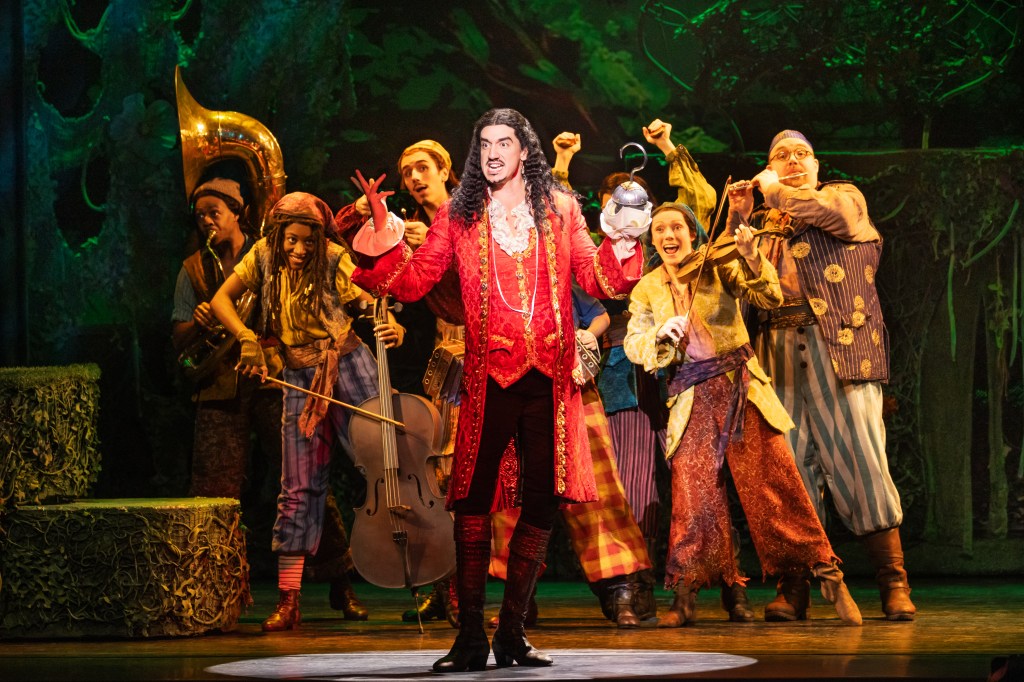
What works better is the diversification and the updates to the Tiger Lily storyline. As most of the show takes place in a fantasy world, there’s no reason not to have a diverse cast. Writer Fasthorse did a great job of removing the more offensive material around Indigenous people in the original production. It’s also great to see Tiger Lily and Wendy forming a friendship, rather than being rivals for Peter’s attention. Wendy is also given a bit more agency of her own and even gets to take part in sword fights.
Director Lonny Price stages the show beautifully, incorporating lots of interesting effects. The Tinker Bell design by Paul Kieve is lovely (and at times, difficult to decode) while the screen projections add something nice to the flying scenes. Lorin Latarro’s choreography is particularly great in the tap number, while Anna Louizos’s scenic design is one of the highlights of the show.
Peter Pan has been a favorite story of mine since I was a small child, having been introduced to the story through the animated Disney film. Then, I fell in love with J. M. Barrie’s book, and later the play adaptation. The national tour of the musical reminded me of how timeless the story is, based on the reactions of the delighted children in the audience. While the changes to reduce the racism in the Indigenous plotline are fantastic, the other modernizations feel somewhat unnecessary. Barrie might have originally written the story in 1904, but the beauty of a child’s imagination and the combined fear of and fascination with growing up will always be captivating.

You can find tickets and more information about the show on DPAC’s website.
Photo Credit: Matthew Murphy at MurphyMade


 Culture Cabinet
Leave a comment