
This review contains spoilers for the film One Life.
Lately, I’ve been consuming a lot of media about the Holocaust, not on purpose, but by chance. I read and reviewed Rebecca Connolly’s new book, Hidden Yellow Stars, about two Belgian women who hid hundreds of Jewish children throughout World War II. I read Heather Morris’s The Tattooist of Auschwitz to prepare for the upcoming television adaptation of it. Finally, I watched One Life, James Hawes’s new film about Sir Nicholas Winton, who helped hundreds of Jewish children in Czechoslovakia escape to the United Kingdom as the war was beginning.
One Life is, in many ways, your typical British biopic. However, it’s elevated by strong performances and the important, largely forgotten story it tells. Lucinda Coxon (mostly known for The Danish Girl, but also as a prolific London playwright) and Nick Drake adapted Barbara Winton’s book If It’s Not Impossible…The Life of Sir Nicholas Winton, based on her father’s life.
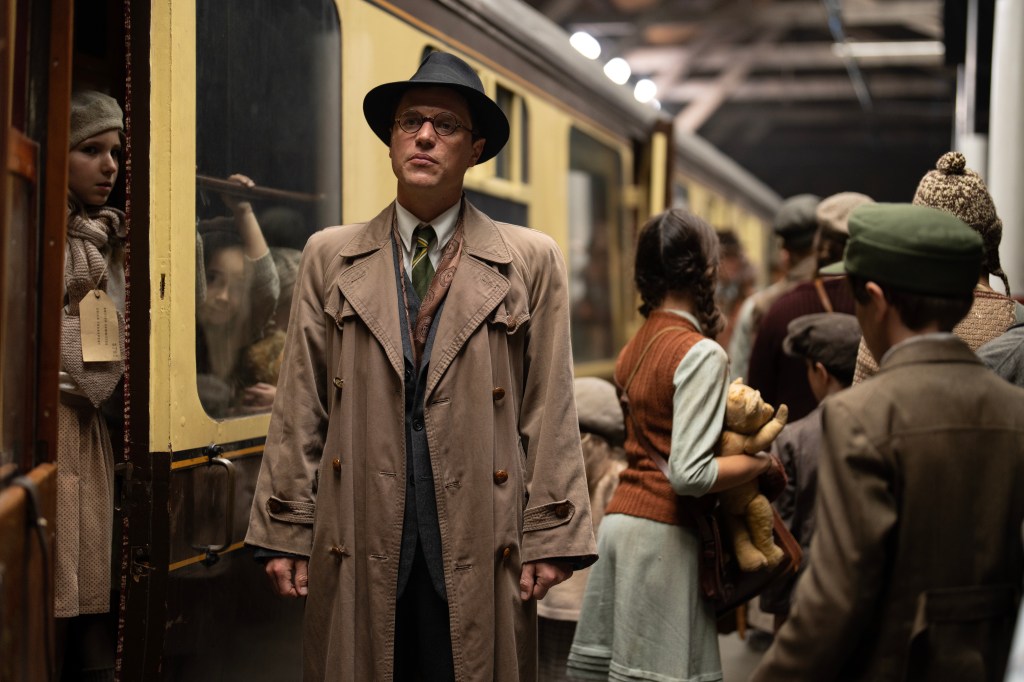
Winton was the son of German-Jewish immigrants who had moved to Britain around the turn of the century. The stockbroker was horrified when he learned about the Jewish refugee children living in camps in Czechoslovakia and fearing Hitler’s seemingly inevitable invasion. He organized lists of children, returned to London to work to get them visas, and arranged for homes for them to stay in until the end of the war. Known now as the Czech Kindertransport, the efforts of Winton and his collaborators saved the lives of 669 Jewish children.
Coxon and Drake made the excellent decision to tell the story in two timelines: one in which a young Nicholas works to save the Jewish refugee children in Czechoslovakia and the other in which the older Nicholas is trying to find a proper home for the documents he still has related to the Kindertransport, after going through his house in preparation for the birth of his first grandchild.
Johnny Flynn transforms himself into the brown-haired, soft-spoken “Nicky” in a way that makes him hard to recognize, even if you’re familiar with his work as a musician or in Autumn de Wilde’s Emma. He brings Nicholas to life in a way that both makes it surprising that this unassuming man took on the task of saving hundreds of lives, and also completely believable that such a man could and would be capable of running such an operation. His determination and despair both show clearly in his eyes, even as he’s quietly charming the children into trusting him.
The older version of Nicky is played by Anthony Hopkins, who has certainly proven that his age has not stopped him from giving great performances. While not as showy as his turn in The Father which won him an Academy Award a few years ago, his performance as Nicky is nuanced and thoughtful. Both Flynn and Hopkins do an excellent job of showing how Nicky blames himself for not being able to save all of the children, even without words.
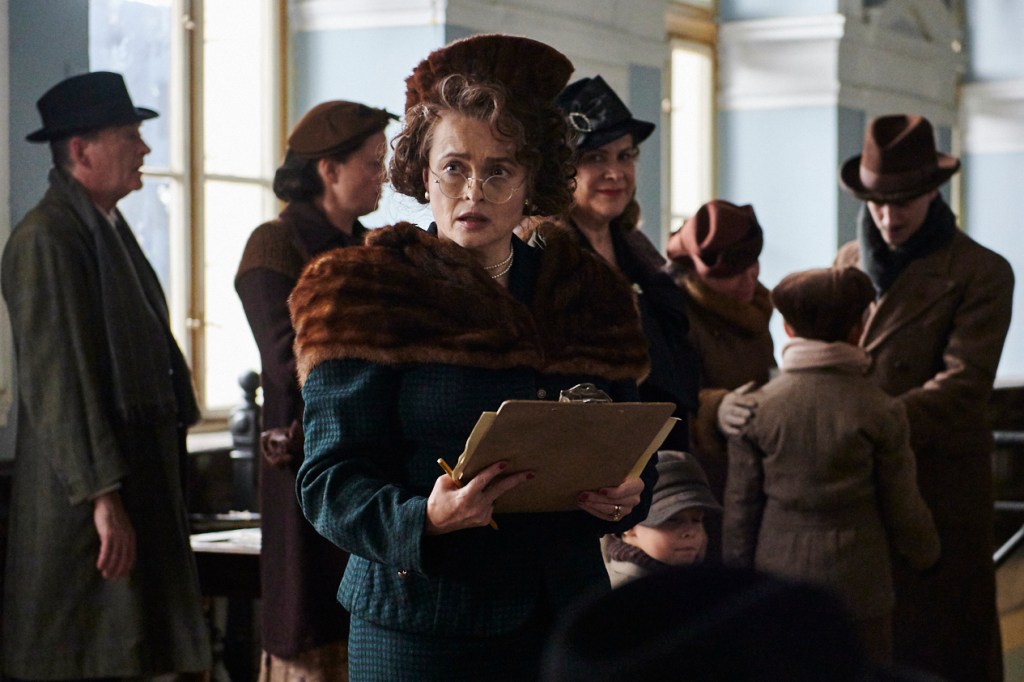
The rest of the cast is also excellent. Helena Bonham Carter portrays Babi Winton, Nicholas’s mother, who eagerly takes on helping with her son’s work and stubbornly insists that the British government cooperate with them. It’s the sort of grounded role that reminds one of Bonham-Carter’s earlier work in period dramas. Hopkins also shares a brief reunion with Jonathan Pryce, who portrays the elder version of one of his collaborators, but his screen time is minimal.
Romola Garai and Alex Sharp, as Doreen Warriner and Trevor Chadwick, two of the people involved on the Prague side of the Kindertransport, stand out amongst the cast. The Kindertransport staff’s desperation as Hitler’s army creeps closer to Prague is palpable, and director Hawes excellently builds tension as they try to save as many children as possible. Lucia Zucchetti’s editing keeps the pacing brisk, as even the scenes portraying the bureaucratic paperwork Nicky must fill out don’t drag, and the painful goodbyes between parents and children keep emotions running high.

Volker Bertelmann’s evocative score also makes it easy for the audience to get swept up in the Kindertransport’s race against time (or rather, against the Nazis). Bertelmann recently won the Academy Award for his score for All Quiet on the Western Front, and while this score is not as unconventional as that one, it’s still proof that he’s one of the most exciting composers working today.
The film ends with what feels like a punch to the gut, but in the best way possible. Nicky is very humble about the work he did for these children, insisting that it’s “nothing to brag about.” But the ending of the film reminds us that Nicholas Winton made a real difference made a real difference, even if the way the Kindertransport ended made him feel as though he had failed.
At one point in the film, someone tells Nicky, “You have a lot of faith in ordinary people.” “Because I’m an ordinary person,” he replies. Both Flynn’s and Hopkins’s performances make it clear that Winton was a normal person, one who saw suffering and did everything he could to prevent it.
Experiencing stories of the Holocaust and those who fought to prevent the Nazis’ attempt to eradicate Jewish people from the world hits differently right now. We are watching an attempted genocide in real-time via social media and seeing the death count of Palestinian children rise every day, while also having witnessed the rise of anti-Semitic hate crimes in the United States over the past few years. May Nicholas Winton’s story be a reminder that it’s not necessary to stop a war or save a whole people to stand up for what’s right and make a difference.




 Culture Cabinet
Leave a comment