
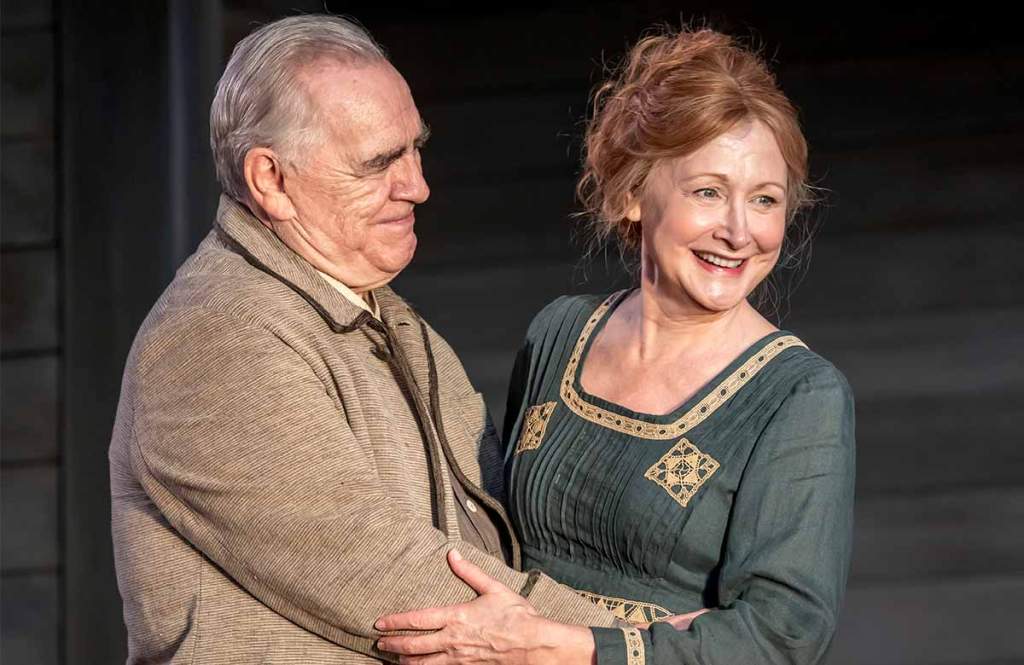
Eugene O’Neill’s semi-autobiographical family drama, Long Day’s Journey Into Night, returns to the Wyndham’s Theatre in London’s West End. A previous production starring Jeremy Irons and Lesley Manville had been at the theatre in 2018. The play was written between the years 1939 and 1941 with the caveat that it would not be published until twenty-five years after O’Neill’s death. His wife, however, had it published and produced a mere three years after his death, in a move that is oddly fitting for the play’s subject matter.
Long Day’s Journey Into Night tells the story of the Tyrone family over the course of a day in 1912. From the start, it’s obvious that there’s something hanging over the family, an uncomfortable spectre which lingers like the oft-discussed fog outside the house. The cause of this unease is slowly revealed as they are unable to let the past lie.
Brian Cox, fresh from his Succession success, plays patriarch James Tyrone, who is worlds away from Logan Roy. A former actor whose career floundered after getting typecast in a commercially successful role, James has spent his later years as a landowner and investor with varying levels of success. He’s a man lost in glory days, having lost the battle between financial stability and artistic integrity. Frequently decried as a miser by his sons, the play makes it obvious that the one area in which James is extravagant is in his purchase and consumption of alcohol, a vice that is inherited by his eldest son and to a lesser degree by the younger.
This is far from Cox’s finest performance; he is frequently stumbling through lines with uncertainty. But in the moments where he navigates the wordy prose with ease, he is rather magnetic, and you get a sense of the showman that a young Mary fell in love with after seeing him perform as the titular Count of Monte Cristo. The scene is which he opens up to Edmund about his difficult childhood was compelling, and was a high point in Cox’s performance.

Patricia Clarkson (Gray, Sharp Objects) brings Mary to life with a captivating delicacy. Whilst all the Tyrones are haunted by the past, Mary’s troubles are overarching for the entire family, and she unravels over the course of the play. Deeply affected by trauma in her past, she has been addicted to morphine since the birth of Edmund. Clarkson is heart-breaking as Mary, in the grip of morphine, regresses to her teenage self as a means of escaping the pain of her adult years. It could be easy for this performance to seem unnatural, but she imbues the role with honesty. It’s a sympathetic portrayal of addiction and the audience can’t help but empathise, feeling a concern for her as her family fret over her well-being and whether to fully disclose the nature of Edmund’s illness. She was very affecting during the play’s climax, appearing out of the upstage gloom in the grip of morphine. Whilst this has been billed as Cox’s vehicle, the production truly feels as if it is hers.
As Edmund, the role based on O’Neill himself, is Laurie Kynaston (The Doll Factory, Spring Awakening). Edmund is a morose young man struggling with his health. An admirer of philosophy and poetry who quotes Nietzsche and Baudelaire, and a self-professed lover of death. He charts Edmund’s journey over the course of the play deftly, infusing the role with a touch of humour in its lighter moments. He was particularly captivating in the scene where Edmund has a heart to heart over a game of cards with his father and tells him of his time away at sea, describing the one time he felt truly free. Kynaston was a late addition to the cast, having been announced a little over a month before the play began performances, having replaced Anthony Boyle who in turn replaced the initially announced Alex Lawther.
Playing troubled eldest son Jamie is Daryl McCormack (Good Luck to You, Leo Grande). Like his father and namesake, Jamie is an unsuccessful actor who is stymied by his dependence on alcohol. O’Neill’s brother, James, upon whom the character is based, died of alcoholism in 1923. There’s an edge to McCormack’s Jamie that is simmering beneath his surface like a snake in the grass. He builds this danger slowly, dropping a hint here and there until the audience truly understands why James and Mary are so wary of him. Jamie is aware of this aspect of his nature and McCormack’s revealing of this when he returns home late and drunk is as unsettling as it is blasé.
Louisa Harland (Renegade Nell, Derry Girls) provides some much-needed levity as Cathleen, the family’s maid. Harland spends the majority of the play off-stage, but when she’s onstage she is warm and sharp. Her scenes with Clarkson and Kynaston are welcome bright spots in what would otherwise be an unrelenting meditation on a family at its lowest. As she proved as Orla in Derry Girls — a role which is worlds away from the earthy Cathleen — Harland has impeccable comedic timing and charm.

The spartan set, designed by Lizzie Clachlan, emphasises Mary’s frequent declarations of how the house has never been a home to the family and how James built it with the cost, rather than comfort in mind. The bare, wooden furniture and lack of personal touches means that there is nowhere for the cast, or the writing, to hide. Paired with the set design is Jack Knowles’s lighting design, which is overwhelmingly natural and dimly lit, adding to the realism of the piece. There is a moment in the second half in which the half-light is replaced with a blinding white flood, wonderfully reflecting an emotional moment like a crescendo. Tom Gibbons’s original music and sound design guides the audience subtly. It never overpowers the scenes, instead it carefully underscores key moments, setting the audience on edge. The foghorn playing throughout the interval was a brilliant, immersive touch. Hearing it for twenty minutes allowed the audience to understand the family’s plight in having been disturbed in the night by it.
Jeremy Herrin’s (A Mirror; Best of Enemies) direction of the drama truly emphasises the long in the title. The play meanders through at a snail’s pace, clocking in at an eye-watering three and a half hours including the interval. The second half drags despite having some of the more interesting conversations between the family, suffering from the deepest lulls. There are pregnant pauses aplenty, lines being delivered a hesitation after they feel they ought to. These choices in direction lead to what would be key emotional moments not quite hitting the mark, lacking urge and drive. One thing that didn’t quite work were the long blackouts between each act, especially as they were not in place to accommodate scene changes. Again, like the line delivery, they wait a fraction too long.
An iconic piece of American twentieth century theatre, this serviceable revival fails to live up to its enduring legacy.

Long Day’s Journey Into Night is on at Wyndham’s Theatre until 8th June. Tickets are available for purchase here.
Photo credits: Johan Persson


 Culture Cabinet
Leave a comment