

Is there anything scarier than puberty and all of the confusing feelings and changes that accompany it? Inside Out 2 finds a thirteen-year-old Riley (now voiced by Kenginston Tallman) excited to start high school and hopefully earn a spot on the hockey team. It’s an excellent choice from script writers Meg LeFauve and Dave Holstein as the years plagued by puberty are a notoriously emotional time in our lives, providing lots of opportunity for Riley’s emotions to run haywire.
In the first Inside Out (released in 2015), Riley struggled to cope with her family’s move from Minnesota to California. Now, she’s happily settled into life with her two best friends, Grace (Grace Lu) and Bree (Sumayyah Nuriddin-Green), and their success on their hockey team, the Foghorns. She dreams of getting a spot on her high school’s hockey team and winning the respect and admiration of the captain Valentina (Lilimar Hernandez). Luckily, she’s presented with an early chance when the high school hockey coach (Yvette Nicole Brown) offers the three girls the last spots in the hockey summer camp that Riley hopes can win over Coach Roberts before they even reach their new school.
In Riley’s head, Joy (Amy Poehler) is still happily the leader of all of the Emotions: Sadness (Phyllis Smith), Anger (Lewis Black), Fear (Tony Hale replacing Bill Hader), and Disgust (Liza Lapira replacing Mindy Kaling). Her personality islands are still thriving, with some changes and new additions, and her beliefs come together to create her sense of self. It’s a fascinating approach to what makes someone uniquely themselves, and it’s sure to be as useful to child therapists as the first film.

The animation for the glowing strands of beliefs is lovely and it stands out against the more colorful animation of the rest of Riley’s mind and the realistic approach to Riley’s external life. We see that Riley has a carefully curated combination of self-confidence, love for her friends, and an inclination to help others. However, when puberty commences, chaos breaks loose in Riley’s mind. The flashing alarm and the demolition crew feel all too similar to my memories of those formative, but formidable years.
Outwardly, Riley bears the physical signs of this transformation: subtle pimples dot her face and braces sit on her teeth. Inside, four new emotions arrive, throwing the well-established group dynamic out the window. Ennui (Adèle Exarchopoulos) is a too-cool-for-anything French girl, too unbothered even to stand up and use the console, who relies on her phone to influence Riley. Embarrassment (Paul Walter Hauser) is a large pink being, who utters few words and hides his face in his sweatshirt’s hood. Small, energetic Envy (Ayo Edebiri) is determined not to be left out of anything. But it’s Anxiety (Maya Hawke) who is the clear ruler of the group.
Anxiety explains that it’s her “job to protect [Riley] from the stuff she can’t see,” and quickly demonstrates that Joy is out of her league when dealing with high schoolers. It’s sometimes difficult to watch Riley’s desperation to be accepted and willingness to mold herself into what she thinks will win her the friends and position she wants, an all too firm reminder of the way that teenagers often act.
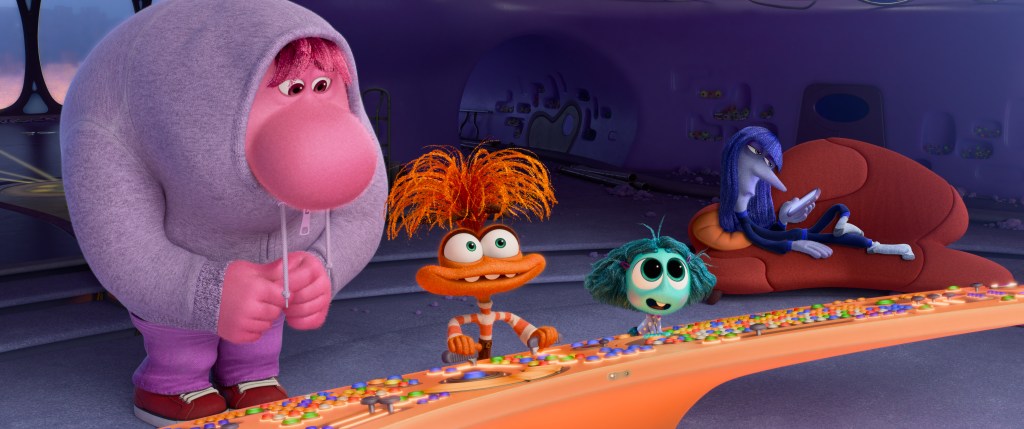
While Anxiety and Riley’s other new, more grown-up Emotions try to help her navigate her way through hockey camp, Joy and the original crew set off on a quest to save Riley’s sense of self from exile in the outer reaches of her mind. While the journey can start to feel too reminiscent of the first film, it’s well-balanced with Anxiety’s increasingly frantic attempts to make Riley cool. The sequel is much better at balancing Riley’s internal and external worlds than the first film, ensuring that the audience is equally invested in what’s happening outside of Riley’s mind.
Along their journey, Joy, Anger, Fear, and Sadness meet interesting creations of Riley’s mind, like her video game crush Lance Slashblade (Yong Yea) and her still-beloved favorite children’s TV show character Bloofy (Ron Funches). These characters also allow the audience to play with animation styles, reflecting the anime-influenced look of many video games and the simple 2D animation of shows aimed at preschool children.
Like the first film, Inside Out 2 will have you laughing and might bring a few tears to your eyes, too. While it’s not as tear-jerking as its predecessor, it brings out a more complicated emotional reaction from its adult audience – fitting for a film about Riley’s emotions becoming more complex. There’s plenty for kids to enjoy, but the film is clever enough for older audiences to appreciate. There are also commendable efforts towards diversity, with characters of multiple races and even one girl wearing a hijab.
Furthermore, I couldn’t help but wonder while watching Riley’s fascination and obsession with Valentina – which I could only describe as a crush – if this film hints that a future film might explore Riley’s sexuality and perhaps even the discovery that she is queer.
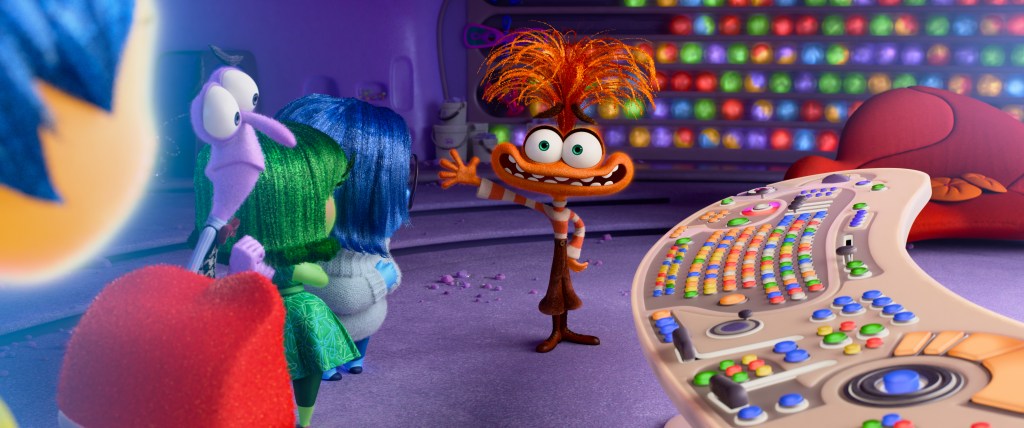
As someone who suffers from anxiety myself, I was nervous about how the film would portray it, and I feared that the film would resort to having Anxiety banished by the end. But it’s handled remarkably well, showing that Anxiety can even be useful when kept in check, but can be debilitating if it gets out of control. Seeing an animated character go through a panic attack was jarring for me, as it felt like a close representation of how my own look and feel, and it made me hopeful that the film might help children who also suffer from them understand what they’re experiencing.
It’s also clear that Hawke’s Anxiety is the star of the show. Edebiri and Poehler also give strong performances, but Hawke’s ability to fluctuate her voice and build to a frantic pitch and pace perfectly suit her character. It’s perhaps not that surprising, considering her excellent portrayal of Robin on Netflix’s Stranger Things, who is prone to anxiety herself, but it proves that Hawke is a more than adept voice actor, which is not something that every film actor can say.
Inside Out 2 is an all-around impressive directorial debut from Kelsey Mann, who has served as a member of the Pixar Senior Creative Team on several films since 2021. It more than lives up to the legacy of Inside Out, giving a much more nuanced and well-developed exploration of its genius concept. Pixar has shown great success with sequels in the past with its Toy Story installments. So while I was never the biggest fan of the first movie, I’m now very hopeful that the creatives might continue with installments of Inside Out as they’ve proven that there’s much more to explore within Riley’s mind.

 Culture Cabinet
Leave a comment