

Hadestown tells the story of the Greek myth of Orpheus and Eurydice, two ill-fated lovers who venture to the underworld after Eurydice seeks shelter from the harsh realities of the world above, leading Orpheus to try and rescue her.
The shelter that Eurydice seeks is offered to her by Hades, the King of the Underworld. Being caught in the throes of issues with his wife, Persephone, Hades seeks out someone who will appreciate the security he feels he’s created in Hadestown. What ensues is what the show proclaims as a “tale of a love from long ago.”
Hades goes by a number of titles throughout the show. We’re first introduced to him as “the king of the mine” in the opening number. He’s called the King of the Underworld. “A mean old boss with a silver whistle and a golden scale.” “King of shadows, king of shades.”
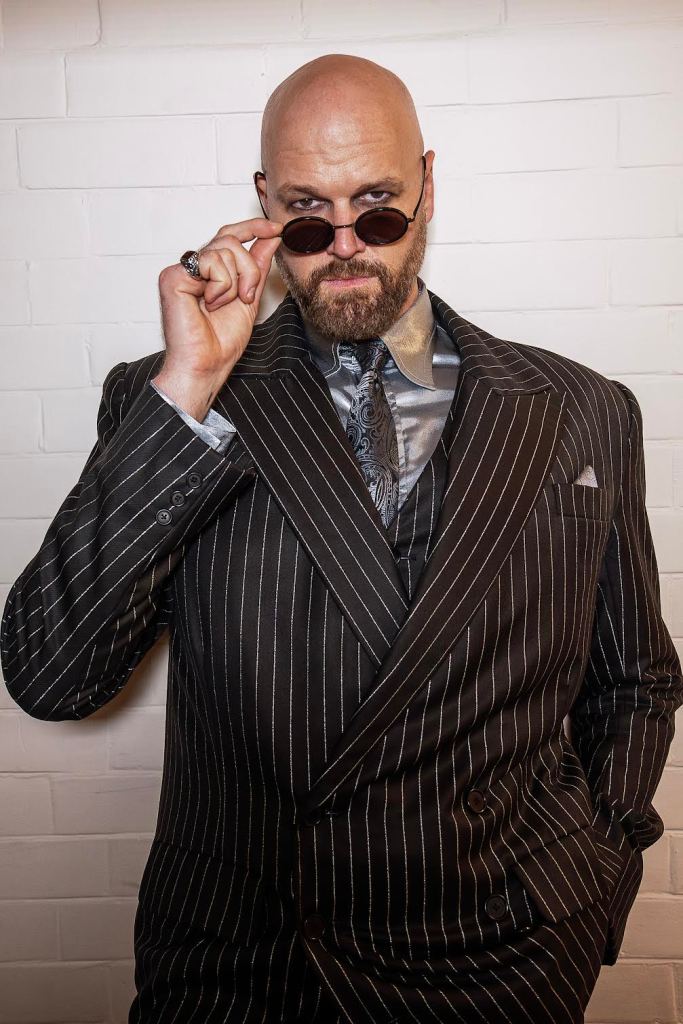
Offstage, he’s Zachary James, who makes his West End debut in Hadestown.
A veteran stage actor, James has made appearances on Broadway in shows such as Coram Boy, South Pacific, and The Addams Family, and has performed in countless operas across the world, earning a 2022 Grammy Award for Best Opera Recording for his work in Akhnaten.
In his interpretation of Hades, James has a commanding presence, with a deep range that soars over Anaïs Mitchell’s Tony Award winning score. He plays Hades with a power that feels driven by insecurity, peeling back the layers as the show progresses to show a vulnerable man who ultimately has just been damaged by his circumstances.
In real life, James feels a touch less intimidating, generously agreeing to an interview with Culture Cabinet. As he sits in his dressing room of the Lyric Theatre in London, surrounded by artwork that feels very reminiscent of the character he plays, I’m introduced to the man behind the King of the Underworld, and our deep dive into the character begins.
“I was doing Sweeney Todd at Opera Omaha a few years ago, and David Neumann, who is the choreographer of Hadestown, was choreographing it,” he says of his initial involvement in the show. “And after our first sing through, I was playing Sweeney Todd, and he was like, ‘You have to play Hades.’ And I was like, ‘Cool. Yeah, sure.’ I had never heard it or seen it. And so then I, of course, checked it out. I got back to New York, I saw the show, and I knew I really wanted to do it.”
In 2023, James was performing in Akhnaten with the English National Opera, when he got the news that Hadestown would be making a West End transfer. After signing with an agent in London, James set his sights on making his Hades dreams come true, and after six months of auditions, he got the call that he had booked the role.
“It was really fast and furious,” he says. “And I was like, ‘Oh, wow, I’m moving to London in five weeks.’”

Hadestown opened in the West End in February of this year, after having its initial pre-Broadway run at the National Theatre in 2018, and opening on Broadway in 2019, where it won seven Tony Awards, including Best Musical, Best Direction of a Musical, and Best Original Score. And, of course, with the show transfer came also a transfer of fans who have passionately celebrated this musical for years.
“It’s amazing to be a part of,” James says of the show’s popularity. “I mean, people are wild for it, it means so much to people. That’s really special to be a part of, and really meaningful to hear and see how important it is to the fan base.”
I ask what he thinks it is about this particular musical that seems to strike such a chord with audiences on a global scale.
“I think to start with, it’s the music,” he says. “The music is the invitation to feel, and it’s very emotional. It’s just the science and math of the chord changes, and the orchestration, and the vocal harmonies. There’s something very emotional about it, and very familiar. It’s similar to music I listened to growing up. I had a lot of bluegrass, and folk, and Americana, and New Orleans jazz in my house. So, it’s very familiar territory.”
“But then, beyond that, story wise, I think you can identify with every character. We’ve all been in those places in our lives. I mean, love is a universal thing that we can all identify with in some way. And heartbreak is a universal thing that we can identify in some way. I think the message of hope is what people hold on to, and why people come back so often, because they really just need to experience those emotions. It touches something deep. And I had the same experience when I saw it on Broadway. I was like, ‘This is alchemy. And I don’t know what’s happening to me, but something magical is happening that I can’t explain.’”

At its core, Hadestown is a character study of two couples who are clear foils of each other. Hades and Persephone stand on one end of the spectrum, representing a love that’s lasted, if turbulently, a love that is so powerful, it creates the seasons. On the other end stand Orpheus and Eurydice, who represent a love that seems doomed from the start. While Orpheus is set to “bring the world back into tune,” his ventures ultimately set Eurydice up for failure, while Hades and Persephone eventually find their way back to each other.
It would be easy to reduce Hades to the villain of the story, with his domineering demeanor, flashy pinstripe suits, power ballads about building walls, and harsh takes on someone like Orpheus. But, James disagrees with such an interpretation.
“I think there’s a lot of similarities [between Hades and] Orpheus. If you think about it, Orpheus can easily become Hades after what happens to him at the end. I think Hades identifies with Orpheus. I think Hades was very similar to Orpheus when he was a young man. And that’s what’s scary, he sees himself in someone else for the first time in a long time. I always have said, and maintain, that Hades is a wounded little boy, who was given the keys to a kingdom he doesn’t want, and he’s made the best of it.”
“His brothers are fabulous and living it up, having a great time in their kingdoms and Hades has the crappy kingdom that he didn’t want, and he has to be all alone. And he’s terribly wounded. He’s lost his parents in a terrible way. His brothers are awful. He has no family. And he finds hope in this one person, in Persephone, and it seems perfect. But then it comes with this caveat that he can only have her half the time. It’s easy to find abandonment issues within him that we can all relate to. No wants to be left, especially by someone you love. You love as much as you’re willing to be hurt in the same measure.”
“And I think Hades and Persephone’s love is a love for the ages. It’s obviously strong enough that it creates seasons. And in equal measure, it can create that much turmoil and pain. I always frame the show as this is the story about young love versus old love. The young lovers are put to a test, and they fail. And it’s not even the test Hades sets out, it’s the initial tests of, ‘Can you take care of me? Can you feed me? Can you listen to me when I talk?’ That’s the test that Orpheus is failing. And meanwhile, Hades and Persephone are put to the test regularly, and they’re overcoming the challenge. They’re really the ones that have a happy ending. So it’s quite interesting, those two parallel love stories.”
It’s that level of understanding of his character that obviously gives way for James to shine in the role. With such an obvious understanding of Hades’ backstory beyond what’s seen in the show, going into the lore of the deity without even being pressed for it, I ask what kind of research he did to prepare for the role.
He sought out books on Hades and Persephone, leaning on everything from the myth itself to other fictional works inspired by the story. He cites Neon Gods by Katee Robert as one of the more helpful sources of inspiration. He also sought influence in statues of the gods themselves at the British Museum.
“But what’s most helpful,” he adds, “is just what’s in front of me on stage.”
And in that department, James can want for nothing. With a brilliant cast that includes Dónal Finn as Orpheus, Grace Hodgett Young as Eurydice, Melanie La Barrie as Hermes, and Gloria Onitiri as Persephone, the West End cast of Hadestown is a stellar ensemble with enough talent to conduct the Electric City.
But, as for what he hopes audiences take away from the show, James’ answer is simple.
“The importance of community,” he says. “I don’t think of Hades as a villain, and I love when people’s perspective shifts. To me, that’s a sign of empathy. Like, you think there was a bad guy, but now you understand him. And empathy is so incredibly important. And something we’re lacking a lot right now. Just trying to understand each other better, even if we disagree.”
He takes it a step further, adding, “And in the same way, like I said, about Orpheus failing and [not being there for Eurydice]. But, you look at them, and you have to understand, he’s like, ‘I have to save the world. I have to write the song.’ So, I have empathy for him because, of course that’s his top priority. And he’s just forgetting his other responsibilities, but empathy and understanding, and within that comes community, because when we understand each other better and listen to each other, and accept our differences, we build community.”
And in hearing him speak of his adamant belief in empathy, I’m suddenly aware of what makes Zachary James’ performance in Hadestown so strong. Despite his power house of a voice, his magnetic presence on stage, and the obvious hard work he’s put into creating his own interpretation of this character, it’s his empathetic approach to not just his character, but the entire work overall.
And on that front, I’d encourage you to take a trip to the underworld to see him in this wonderful show for yourself, if you can. It’s well worth the Road to Hell.
You can buy tickets to Hadestown West End here.
You can stream the Hadestown Cast Recording below.

 Culture Cabinet
Leave a comment