

This review contains minor spoilers for the film.
Let’s get one thing out of the way: Sam Wilson is the correct character to take on the mantle of Captain America. Whatever issues Captain America: Brave New World has, they’re not Sam Wilson or actor Anthony Mackie’s fault.
The film is the thirty-fifth in the MCU and the fourth installment in the Captain America series, though the first without Steve Rogers (formerly played by Chris Evans). While it most directly follows up from the Disney+ television series, The Falcon and the Winter Soldier, it also draws upon plotlines from The Incredible Hulk, Captain America: Civil War, and Eternals.
Sound complicated? Fortunately, you don’t need to have much memory of the films to be able to follow the story. A couple years after we last saw him, Sam (Mackie) is now more confident in his role as Captain America, even if he’s had to learn to work alongside the United States government. In particular, he has some reservations about new president, Thaddeus Ross (Harrison Ford, who takes over the role from the late William Hurt).
We first see Sam in action as he helps the military interrupt a deal with Sidewinder (Giancarlo Esposito) and recover a canister containing a secret material stolen from a Japanese lab. However, in typical Sam fashion, he chooses to save the hostages first while Joaquin Torres (Danny Ramirez), who assumed the mantle of Falcon in The Falcon and the Winter Soldier, retrieves the package.
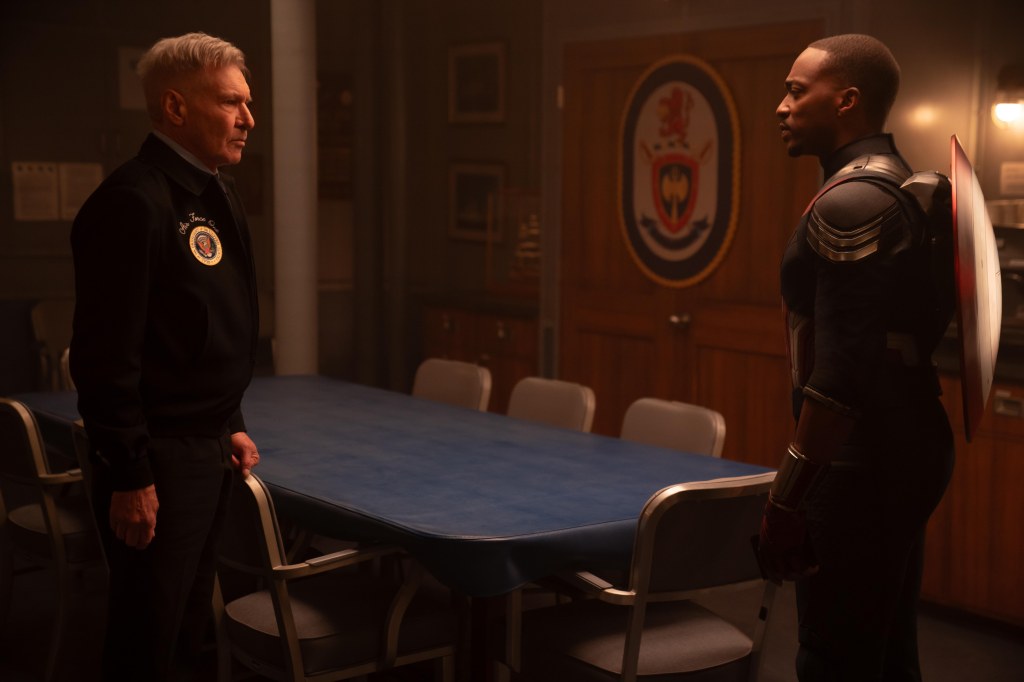
This first action sequence shows the film’s commitment to real effects and intricate fight choreography, which has always been one of the best things about the Captain America films. Sam has a new suit, which combines the typical Cap aesthetic with wings like his Falcon suit. It’s a great tribute to his new role, while also honoring his past in the MCU. This is a version of Sam who’s much more confident with the shield and easily answers to “Cap,” but he’s still his normal sassy self, and committed to always trying to talk down an antagonist before resorting to violence.
The film reunites Sam not only with Joaquin, but also with Isaiah Bradley (Carl Lumbly), the forgotten Captain America who was introduced in The Falcon and the Winter Soldier. The camaraderie between this new trio is perhaps the highlight of the film, with Joaquin teasing Isaiah about his age and the three men marveling over being sent a limo to take them to the White House, after Sam insisted that the president extend an invite to Isaiah when he and Joaquin are invited as thanks for their success.
However, while at the White House for the Celestial Island World Summit, discussing how to deal with the newly found element of adamantium inside the land mass in the Indian Ocean, events occur that land Isaiah back in prison. President Ross tells Sam to stay out of it, but he is determined to exonerate his friend, particularly because he may be facing the death penalty.
Sam’s hunt for the mastermind behind what occurred leads him to Samuel Sterns (Tim Blake Nelson, returning from The Incredible Hulk), a now-deformed scientist who “deals in statistical certainties” and is determined to exact his revenge on President Ross. Naturally, it’s up to Sam to stop Sterns’s plan from coming to fruition, along with the help of Joaquin and Ross’s security advisor, Ruth Bat-Seraph (Shira Haas).
Israeli actor Haas’s casting in the film sparked some outrage when it was announced, along with the character she was playing. However, there’s no mention of the comic book Sabra in the film and only a passing mention of the character being from Israel; instead she’s presented as another ex-Black Widow who trained in the Red Room. The character comes off as somewhat pointless and Haas’s performance is uncompelling, making it seem like a strange choice to include her at all.
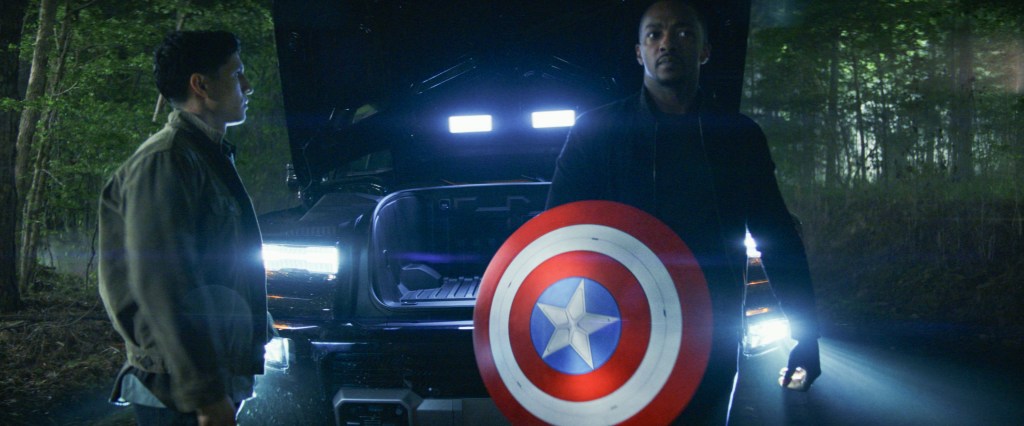
It’s likely that some of the weakness of the character is due to the reshoots the film went through after supposed poor results in early test screenings. Unfortunately, there’s much in the film that just seems to be a victim of awkward timing of its release. While Ross’s character does not seem to be influenced by President Trump at all – he’s motivated by wanting to earn back his daughter’s trust, served in the military, and takes responsibility for his actions – it’s hard to ignore the big red Hulk of it all. The film has the usual Marvel pro-military tint to it, that is particularly unwelcome by many at the present moment.
But more than anything, it’s Sam’s belief in the American government and his commitment to compromising with Ross that feels ill-timed. When Sam says, “If we can’t see the good in each other, we’ve already lost the fight,” it doesn’t hit the same way it might have ten years ago when the country wasn’t so polarized over moral, rather than political, issues.
It’s a bit disappointing to see the film taking this attitude that veers into both sides-ism, particularly when the screenplay had Malcolm Spellman and Dalan Musson, who both worked on The Falcon and the Winter Soldier, as contributors. (Rob Edwards, Peter Glanz, and director Julius Onah also are credited, which perhaps explains why it seems so disjointed.) To go from a television show that seemed genuinely interested in reckoning with what it means for a Black man to take on the mantle of Captain America, and made connections between the Tuskegee airmen and the treatment of Isaiah Bradley, to this more timid approach to the character is disappointing.
Still, there’s much to enjoy in the film from Emmy-nominee Kramer Morgenthau’s cinematography to the well-choreographed action sequences. Onah builds the tension throughout well, and every time the two hour runtime starts to drag, he brings the audience back in with another emotional scene.
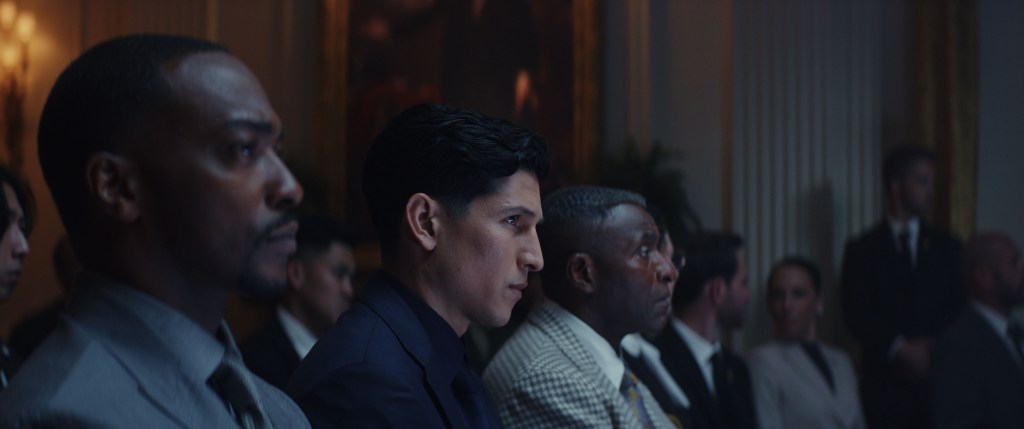
Captain America: Brave New World is at its best when it’s letting its cast shine: from Ramirez’s endearing enthusiasm to Lumbly’s quiet strength and teary desperation. It’s fun to see Harrison Ford having so much fun with a role, and sets him up well for a rumored appearance in Thunderbolts*. When Onah lets Mackie’s charisma stand center stage, it reminds me that there’s a reason his Sam Wilson is so beloved. In some ways, it feels like the movie is a metaphor for Captain America himself: the person at the heart of it is so much more important than the fancy high-powered fighting skills.
At one point in the movie, President Ross tells Sam, “You’re not Steve Rogers.” He isn’t – and that’s a good thing. While Steve would surely have much to say about the world we currently live in – after all, he is a man known for punching Nazis and questioning the government – Sam is the Captain America we truly need. No, his first big film outing with the new role might not be as good at showing why as the television show bearing his former title, but…it’s a start.



 Culture Cabinet
Leave a comment