

“I started playing music as a kid. When I was eight, I started learning guitar. I’ve been taking lessons my whole life,” says Sahara Grim in an interview with Culture Cabinet, reflecting on an artistic journey that spans decades, continents, and one very transformative retreat to the forest. Her debut full-length Fable, produced by Luke Temple (released earlier this year), is not merely an album, but a reckoning. A winding, lushly imagined coming-of-age story steeped in fairy tales, solitude, self-inquiry, and most of all, patience.
“I started writing music when I was thirteen, and have been playing it with a band since I was sixteen,” Grim continues, explaining she studied music and played in bands all throughout her time at University of California, Los Angeles. But when the world shut down in the wake of COVID, so too did her carefully laid plans. “Post college, it was COVID. So when I thought I was stepping out into the world, outside of the school scene, I ended up moving up north to nature, near Big Sur.”
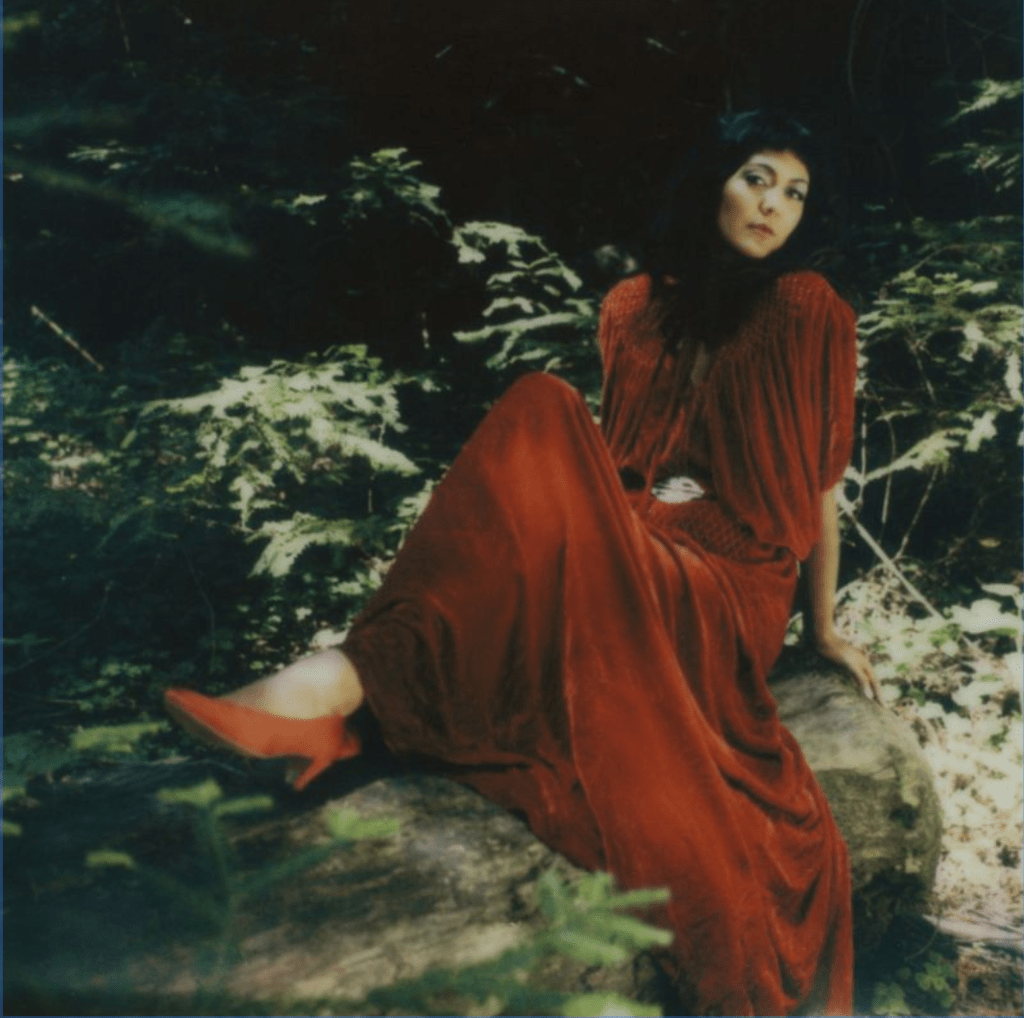
That escape, though disruptive at first, soon became a portal. “This project started naturally coming to me that turned into Fable.” She describes her time living near Big Sur with the quiet awe of someone who found more than peace in the trees. “I started writing these songs as a way to process my own experiences. And because I was waking up in the forest every day, it was this magical setting that was very visually inspiring.”
At the time, she was also reading Women Who Run With the Wolves, a collection of psychological folk analysis and ancestral wisdom. “I was living in a fairy tale setting, and reading this book and writing these songs, and I was realizing that my songs paralleled the messages of a lot of these different stories.” The stories, she says, weren’t just metaphors. Rather, they became blueprints. “The songs are really personal, and it was a way to make them for everyone else in a way that related to them without being too in the details.”
The process was slow and sprawling. “It’s hard to explain, because it was so many years,” she says of the creation of Fable. “It was over four or five years of forming the songs and the ideas.” After returning to Los Angeles, she held her vision close. “I was really holding on to it tight. I was like, ‘I don’t know who I want to make this with.’ I had all these different ideas.”
Eventually, through mutual friends, Grim was introduced to Luke Temple. “I had known of his stuff before. We had all these mutual people, and I just had an intuition about it, and I’m really glad we did, because he had such a clear vision for worlds too and directions to take the songs.” The studio became a sandbox of collaborating and creating.
The album opens with “Solitude,” and the title sets the tone. I recluse and took my time to reground and just find what my personal style and direction was. For Grim, this project marked a shift. “This felt like a full-on stepping into the idea of ‘What’s actually me?’”
Among the tracks that mean the most to her is “Hysteria.” “It was challenging,” she says. “It was a tricky one. Some songs, you finish them fast. They write themselves. ‘Hysteria,’ I really knew it wanted to break through. It’s such a long one. It’s like a movie, almost in a song.” What began as a difficult piece became a breakthrough. “It’s about being too emotional and it making you feel crazy. But ultimately, self-acceptance.” She adds, “As Luke said, it’s a neat song. I love that old school word.”
Then there’s “The Red Shoes,” the first track that came to life. “I made it in my room with my friend Jake, and it was the first song on Fable that was even a thing.” Playful and striking, the track kicked the entire project into gear: “We had a lot of fun channeling the sassy little vibe. And that one really kicked it off. So it has a special place in my heart.”
Another standout, “Time Wanderer,” shows Grim’s lighter side. “It’s just light and it’s really different from all the other songs. You can just put it on casually, it’s a bop, and it’s nothing too heavy.” She recalls collaborating on the track with her friend Naila on harp and watching the sound evolve. “Originally, it was a slow one with no drums, and it really transformed.”
In the end, Grim hopes Fable becomes a space of connection. “I definitely wrote these songs when I was very isolated and just living in my head and not seeing people. It was this very weird time in the world.” But despite the solitude, the aim is not distance, but resonance. “I always say the music I make is for the people it resonates with. But overall, I guess if it made you feel seen, then I feel like I’ve done my job.”


 Culture Cabinet
Leave a comment