
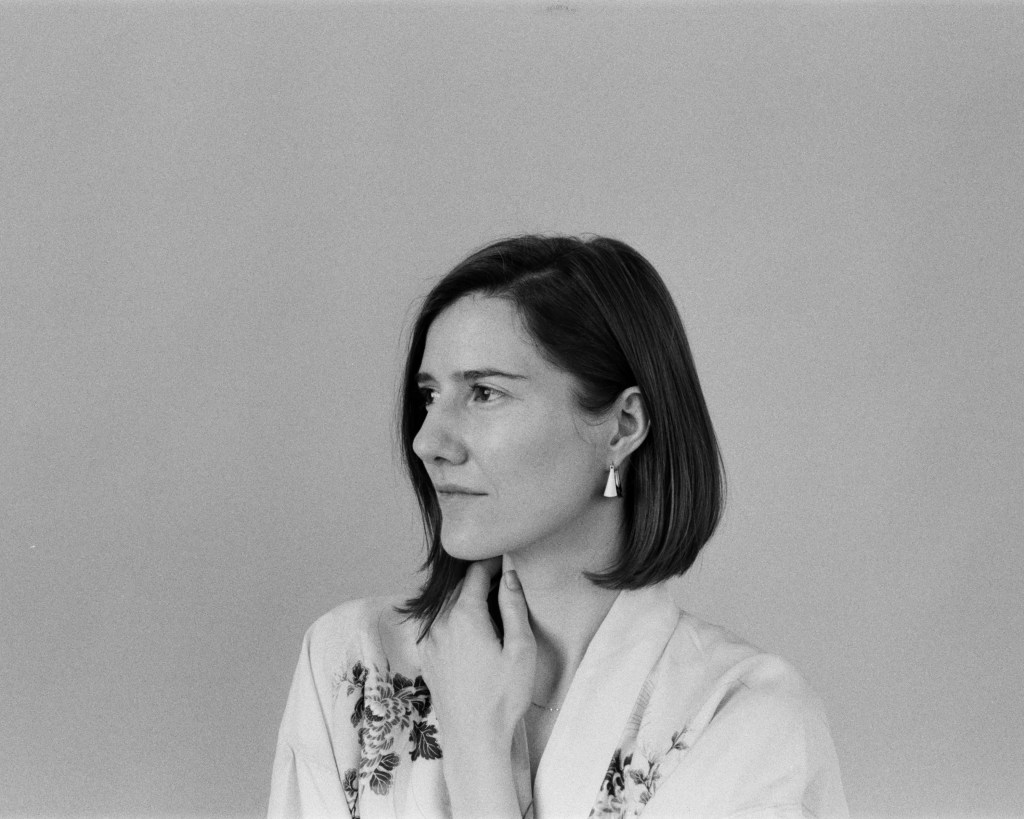
Amelia Wellers, the classically trained vocalist and electronic artist behind Aerhart, has a voice you don’t forget. But it’s not just her operatic background or her hyper-melodic sound. It’s the way her work feels like a reckoning: a softly-lit portrait of transformation, grief, agency, and healing. On her sophomore album, The Keeper, out now, Aerhart turns inward and forward at once, channeling what she calls “little personal vignettes” into a confident new body of work. And for the first time, she’s taken on a production role of her own, making the record not just a declaration of artistry, but of autonomy.
“I’ve been singing since elementary school,” she says in an interview with Culture Cabinet. “I played piano as a child, majored in music, it was my first love. But I didn’t really start thinking of myself as a musician until a couple of hard life moments made me realize how much music, and songwriting, specifically, grounded me.”
The album emerged in response to Wallflower, Aerhart’s first full-length album, written during the isolating depths of the pandemic. That record, created in a vacuum with longtime producer Kyle Joseph, served as an emotional purge of heartbreak and anger. The Keeper, however, takes a wider lens.
“I had a collection of songs with a common thread: post-pandemic relationships, looking for love, sometimes finding it, sometimes not. That search became the foundation,” she explains. “It’s about looking for the people you want to keep in your life. They’re all little vignettes that speak to that message.”
What makes The Keeper particularly resonant is how deeply personal it is, both lyrically and technically. This time around, Aerhart stepped more fully into the production chair, independently producing half the album. “There are three songs that I fully produced, beginning to end, and five that I worked on with Kyle. I usually produce all the way to the end and then get other people’s feedback to help the song be its best self,” she says. “But this was a good record to exemplify how far I’ve come.”
Working with Joseph again offered both familiarity and growth. “He’s wonderful. I’ve learned so much from him about what it is to produce well, and what it means to be an artist,” she says. “Our first collaboration, he was on Pro Tools and I was just digging into Logic. Over time I learned how to better articulate what I wanted. On The Keeper, I had a much stronger vision for my artistry. That’s great for collaboration, but it can also introduce tension, because both people want the song to be its best self. Still, I think we reached a shared understanding of what Aerhart is and what I can bring to the table independently.”
That independence comes not just in sound, but in sentiment. The album’s themes are broad yet intimately rendered, exploring romantic relationships, grief, healing, and the quiet triumph of self-realization. “There’s a lullaby I wrote for a friend’s baby, but I didn’t finish it until a year later when my grandmother died. I realized it was actually a song about the circle of life,” she shares. “And then there’s ‘I Didn’t Know (Crystallized),’ the thesis of the album. It was the first song I wrote after finishing the last record. Wallflower was experimental, angry. ‘Crystallized’ was a complete reversal. Much more forgiving. I call it my ‘Amelia went to therapy’ song,” she adds with a laugh.
That evolution from catharsis to clarity pulses throughout the album, even in songs that began during personal crises. Take “Love Is Simple, Love Is Blind,” which started during a physically and emotionally painful time. “I had an eye injury the week before my last album released. I couldn’t promote anything, just went straight into surgery. I borrowed a friend’s synth and wrote the beats while I was healing. I picked it up again over the next few years, and now it’s the most dance-like, free song on the album,” she says. “It transformed from pain into release.”
Though Aerhart’s early background is rooted in classical and operatic training, she doesn’t consciously bring that into the studio today. “I always knew I wouldn’t be a classical singer, but I loved learning how to use my voice,” she says. “I think what I draw most from that experience is exposure to classical compositions — I’ve sung in so many choirs, I can write for strings without really thinking about it. It’s less about technique now, and more about inspiration.”
That blend of intuition and composition gives Aerhart’s sound its depth. The Keeper may be self-reflective, but it never gets lost in itself. Every song feels generous, holding space for the listener to find their own meaning. That’s intentional. “I hope everyone takes away something different,” she says. “The benefit of writing songs that are so personal is that people can find their own story in it.”
Still, if there’s one unifying takeaway she hopes listeners feel, it’s this: “Everybody is searching for something: a lover, a family member, a community. We’re all on different forms of the same journey. The Keeper is different for everybody, depending on where you are.”


 Culture Cabinet
Leave a comment