
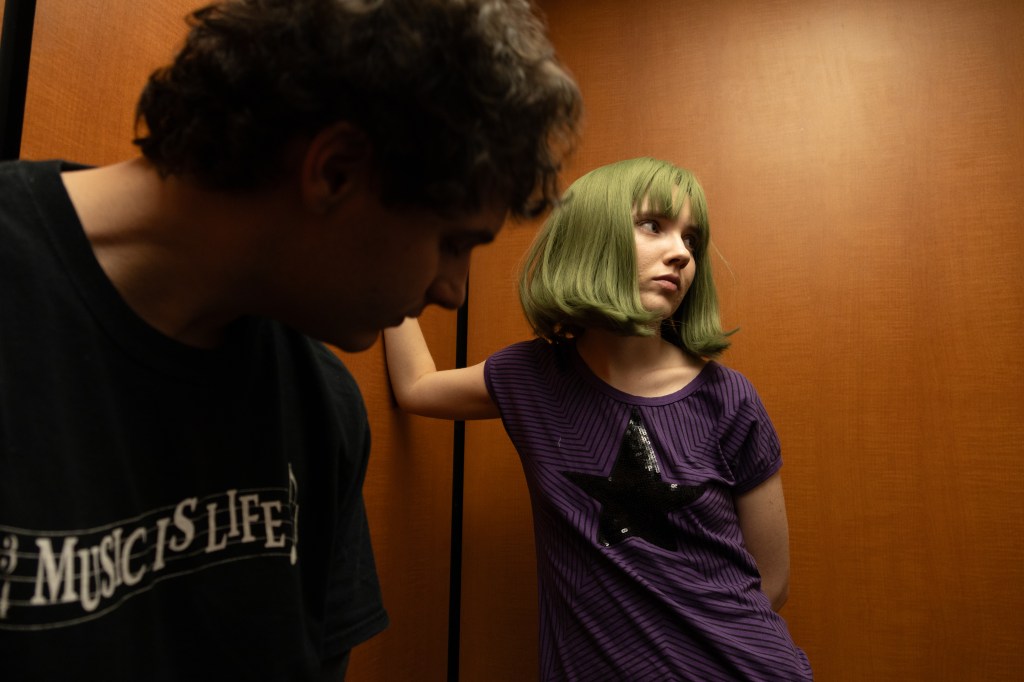
The Brooklyn art rock duo Sex Week are not interested in repeating themselves. If their debut EP announced their arrival with left-field pop playfulness, Upper Mezzanine, their daring, disorienting follow-up (out now), pushes the vision even further, swirling darkness and intimacy into a shape-shifting whole. But as vocalist Pearl Amanda Dickson puts it, that drive to evolve is more instinctive than calculated.
“We started making music together, like, two and a half years ago,” she recalls in an interview with Culture Cabinet. “We met through a friend of a friend and started making music pretty off the bat.” Richard Orofino, the duo’s other half, had already been active as a solo artist for years, while Dickson was a relative newcomer. But their chemistry was immediate. “It was really fun to just start something new together,” Dickson says.

What emerged from that early collaboration was Sex Week’s 2024 self-titled debut: a thrilling, off-kilter EP that quietly became a cult favorite. But by the time the dust had settled, Dickson and Orofino were planning their next move. One that they hoped would top the success of their debut even further. Because, as I learn while talking with them, they’re always wanting to outdo themselves.
“I think with the first EP, it was honestly my first time really making music, besides just being in my room playing guitar by myself,” Dickson says. “So with the second one, I was like, ‘Okay, now I feel ready.’ Like, I did it once, and now let’s do it again. I learned so much.”
Orofino agrees. “I just feel like that’s always gonna be our goal. Like, ‘Okay, cool, that’s fun.’ But the next thing is gonna be better. I don’t know what it is yet, but we have to keep that kind of energy and hope.”
That hope runs like a subtle current through Upper Mezzanine, even as the record leans into the bleak. These songs were written with more time, more intention, and more emotional weight. “Something like ‘Coach,’ for example, is lyrically a really, really sad and messed up song, in my opinion,” Dickson says. “But I wanted it to feel like there’s a weird hopefulness in the production side of it.”
Though, despite a reach for hopefulness, an overarching theme of anxiety sits at the foundation of the EP’s themes. “The fear and anxiety, I think, is just going to naturally be present,” Dickson continues. “Because when we’re making the music, it’s just how it feels in the world right now. So it’s going to leak through no matter what.”
And yet Upper Mezzanine isn’t too somber. “Another element that we try, more on the hopeful side, is sort of the idea of that no matter what, we have the people we love,” says Orofino. “That’s also a through line throughout all of it: the weirdness of it all, and the scaries, and there’s still that.”
That emotional duality, where pain and comfort can share the same breath, is the thread that pulls Upper Mezzanine together. “Money Man,” the final track on the EP, nails that balance. “There’s a lot of stuff going on,” says Dickson, “but the verse says, but we have each other, and we have people we love, and that’s enough.”
If their first EP was built on instinct, Upper Mezzanine reflects a more deliberate process, or an inquisitiveness that shaped every decision. “It’s always like, what is the weirdest choice?” Dickson says. “This feels right, but what is the thing we’re not even thinking about?”
That tension between what feels familiar and what feels unhinged became a guiding force. “The questions are like, cool, we like the song, but how can we disguise it?” Orofino explains. “Just messing around with really different worlds. Some of the songs don’t really fit with the others so much, but we try and make the thing that makes it feel cohesive our voices and the things we say.”

And unlike the first project, which came together quickly, this one took its time. “A lot of this EP is a lot of songs that we didn’t feel like were ready for the first EP,” says Dickson. “So it feels like we’ve had so much time with these core songs, that we could really just produce them out.”
Orofino, too, found growth in slowing down. “I find myself, over the years, being very quick with songs and not living with them,” he says. “I learned that I can participate in having a song exist for a year and just check up on it every once in a while. Like, I still love this, and that’s cool.”
The duo’s ever-shifting sound defies simple genre classification. They cite influences as disparate as Deftones and Lady Gaga. But for their next project, they’re planning to challenge themselves by reining in those endless possibilities. “We can find any sound in the world these days,” Orofino says. “So when we do the [next] album, we should just have, like, six things to choose from, and that’s it. In one room. We’re not allowed to step outside that so much.”
“It might force us to be more creative by being more restricted,” he continues. “What if you love both Deftones and Lady Gaga, but you only have three instruments? Then what does it sound like?”
It’s clear they’re still figuring it out, though they seem to think that’s the fun part. “It’s really exciting,” Dickson says. “And I feel like we haven’t really tapped into our sound. So it’s kind of fun to think about doing an album next. What is Sex Week in the context of 15 songs?”
Ultimately, their hope is that listeners feel as much as they hear. “I’m always hoping that they like it as much as we do,” says Dickson. “I feel passionate about it. It’s the music I want to listen to.”
Orofino agrees. “I love when I listen to something and go, ‘Oh, that’s such a fun choice. Why did they use that sound? That’s the worst sound ever, but it’s kind of cool.’ It’s not so serious, but it works.”
With Upper Mezzanine, Sex Week is stretching the limits of what vulnerability can sound like. Sometimes dark, sometimes absurd, always honest.


 Culture Cabinet
Leave a comment