
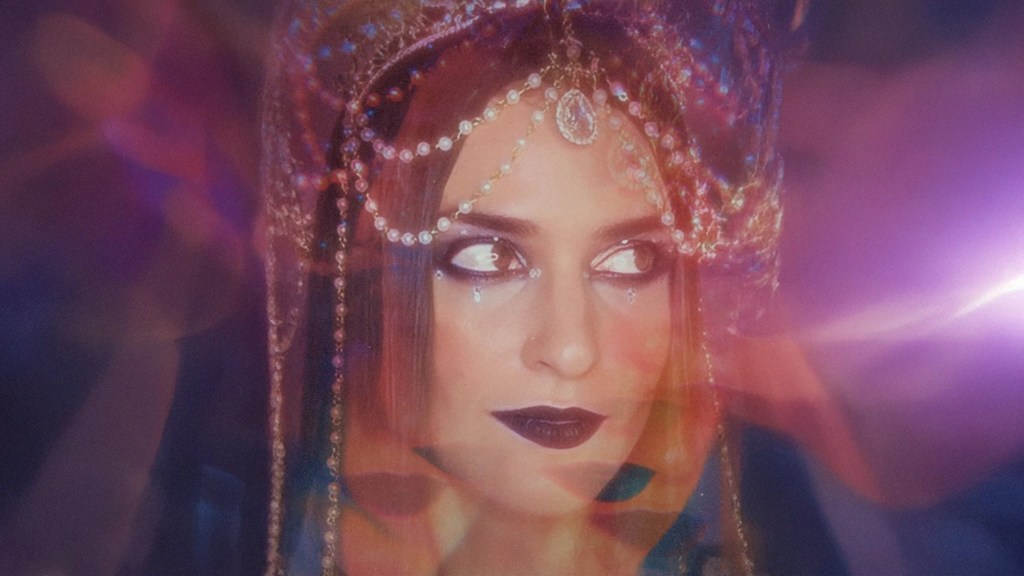
There’s a rhythm to the way Eleri Ward talks about her music. It’s not so much in the predictable patterns of rehearsed promotion, but in waves. Her sentences bend and swell, her thoughts looping back on themselves until they settle somewhere that feels like revelation. She speaks the way her songs sound: intuitive, exploratory, unafraid of where they might lead. The kind of subject that makes a music journalist’s job easy.
As Ward herself recounted to Culture Cabinet last year, her gift for music began before she even knew how to read. From there, her path curved through voice lessons, community theater, and musical study that took her from the Chicago Academy for the Arts to Berklee College of Music, and later the Boston Conservatory.
It was there, in rehearsal rooms and practice studios, that Ward began chasing a sound that didn’t have a precise label. She stood at the crossroads of classically trained but creatively curious. She was a singer with one foot in theater, one in the cosmos, and an imagination too restless to stay contained. The combination would come to define her: part stagecraft, part spellwork, entirely singular.
Her early career unfolded in unexpected ways. In 2019, an unassuming Instagram post, an acoustic rendition of Stephen Sondheim’s “Every Day a Little Death,” suddenly went viral. Within months, Ward’s delicate, folk-tinged take on Sondheim’s catalog blossomed into two acclaimed albums (A Perfect Little Death and Keep a Tender Distance) and a devoted following and praise from critics.
For most artists, that kind of critical success would be an endpoint. A lane established, a niche secured. But for Ward, it was only an overture. She toured with Josh Groban, starred off-Broadway in Only Gold and in the American Repertory Theater’s Gatsby, and then, somewhere amid all that theatrical glow, she began to feel a shift. The songs she wanted to write were no longer other people’s. They were her own.
When she released single “Moss” in 2024, it felt like a clearing after the storm, the soft, fertile ground where something new could grow. But even then, Ward was already standing at the threshold of what would become her most self-defining work to date. “I think ‘Moss’ really was the turning point of being fully committed and dedicated to my original work,” she says in an interview with Culture Cabinet. “I think the difference between that release and really making [Internal Rituals] was I had started writing some of the songs by the time ‘Moss’ was actually released, but I didn’t totally know that it was going to be a full album until later on. The story of the album organically started unraveling as time was going on.”
That unraveling became Internal Rituals (out now), a record that traces her transformation not as an aesthetic shift, but as a full-bodied act of becoming. Written and produced largely on her own, the album is both meditation and metamorphosis, a sonic document of Ward tuning herself to a new frequency. “Life feels very different from ‘Moss,’” she admits, “like now Internal Rituals versus ‘Moss’ feels like two different me’s, which is kind of the point of the album, a little bit.”
If ‘Moss’ was grounding, Internal Rituals is ascension. She describes its lead single, “Venusian Light,” as that very leap: a lush, shimmering track born out of literal celestial guidance. “I kind of view ‘Venusian Light’ as this ascension beyond ‘Moss,’” Ward says. “Like this discovery of being rooted and grounded and all that, and then this whole experience of understanding yourself more deeply, and identity shifting and quantum leaping into a new reality where you view everything totally differently. It kind of like takes that ‘Moss’ feeling and shoots it out into outer space.”
The cosmic language isn’t just affectation. For Ward, astrology, spirituality, and self-reflection all live in the same creative orbit. She laughs when she describes herself as a “woo-woo girlie,” but her dedication to inner work is anything but performative. “Songwriting is this ritual that helps me better understand my own personal experience,” she says. “I was doing that as I was going through this weird transitional, eye-opening time.”
The last two songs,“Goodbye Sojourna” and “Venusian Light,” would become the emotional coda of Internal Rituals, written at a time when her personal and creative lives were finally aligning. “I was about to get married to the love of my life and so many good things were happening last year that made me feel settled into myself,” she says. “I needed to experience that in order to write ‘Goodbye Sojourna’ and ‘Venusian Light.’”
Listening to Ward talk about her art, it’s clear that “process” isn’t just a behind the scenes concept. It’s the point. Every note, every lyric, every brushstroke of sound is tethered to a moment of lived experience. “I was experiencing the story of the album in real time,” she says, “and thus had to write it in real time.”
Still, Internal Rituals isn’t born from chaos. Its composition, though fluid, is deliberate, a constellation of songs orbiting around a single truth: evolution requires surrender. “There was no preconceived notion of what it had to be,” Ward says. “I was letting it tell me what it wanted to be.”
At its heart sits “Stepping Through,” the track she calls the foundation of the whole record. “Once I had written ‘Stepping Through,’ I knew that had to be the first song, because that sets up everything,” she explains. “There is this questioning of identity, and there is this shift, and there is this like tectonic plate that’s moving beneath your feet. It sets the stage for all of these other songs that end up being explorations of what that is, and thus answer the question that ‘Stepping Through’ poses.”
She recalls how that same journey led her, one August evening, to a song that would answer ‘Stepping Through’’s call. “I was reading about the Venus transits that were happening,” she says. “And I was like, ‘Oh, this actually so embodies how I feel right now.’ And I just felt so expansive and so lush and yummy. And then as I was journaling about Venus, I was like, ‘Wait, no, I need to write this song.’ And that immediately fully answered the question that ‘Stepping Through’ had already posed to me, and I just knew that had to be the end.”
In conversation, Ward balances the ethereal with the deeply grounded, a quality that mirrors her career path itself. Having first emerged in the world of musical theatre, her reputation for Sondheim reinterpretations preceded her. But Internal Rituals marks a deliberate reclamation of her identity. “I’ve had to undo a lot of what I thought I had to be in order to be understood or marketable,” she says. “It really doesn’t matter. It’s not my job to try to get people to understand me. It’s my job to make the thing that my brain is telling me I have to make. That’s my duty.”
“There are going to be people who don’t get it, don’t want it, don’t like it, and they only want to listen to the Sondheim stuff, but that’s what it’s there for. That’s fine. I’m not going to stay stuck in a time warp where I’m just being this past version of myself, because that’s what a certain amount of people want me to be.”
It’s a bold declaration, but also a liberating one. “I thought at one point it was [my job to educate people],” she says, “but it’s not my job to educate people on who I am now. It’s my job to do the art that I want to do, and the art will be the educator.”
That conviction is part of what makes Internal Rituals so magnetic. It’s an album that sounds like self-possession. “As long as I am fulfilling myself, it is done,” Ward says. “Like, it is fine. Everything is good. I am only winning.”
And perhaps that’s why Internal Rituals feels less like a collection of songs and more like a door to a cosmic realm. One that asks listeners to look inward as Ward did, without flinching. “With this album, I really hope people [take away that] embodying their most authentic selves, the only way to really get there is to look at yourself fully,” she says. “I hope that people listen to this album, and by me sharing my journey of introspection and looking at myself, other people can look at themselves and perhaps have a different experience of the world around them.”
“If I want my own ‘Venusian Light,’ I gotta go on this whole crazy-ass journey of my mind being blown looking in the mirror every day, because that’s the only way to it.”

 Culture Cabinet
Leave a comment