

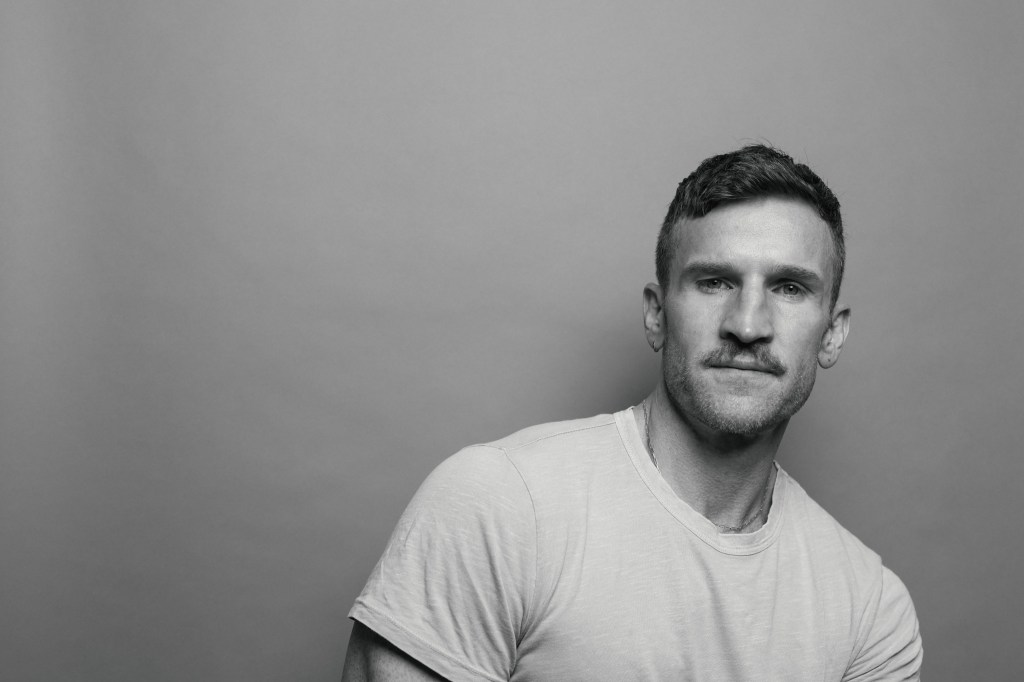
Noah Floersch never set out to make music the way other people did. He just couldn’t help himself.“I didn’t really grow up in a particularly musical household on the making side of things,” Noah Floersch says in an interview with Culture Cabinet. “We had a piano in the house, but nobody really played it. So I was around it. We were big music fans.” His mother listened to Fleetwood Mac and the Dixie Chicks; his father leaned toward U2 and Dave Matthews Band. “There was good music floating around,” he recalls. “But around seventh or eighth grade, I started listening to my own kind of stuff.”

When Mumford & Sons were “the hottest thing,” the Omaha native asked for a banjo for Christmas. “I realized very quickly that I did not have the discipline necessary to master the instrument,” he recalls. “So in my head, I was like, ‘Okay, screw it. I can’t play anything else. I might as well make up some of my own stuff that I can play.’”
The impulsive gravitation towards making up something of his own was the first spark. “The songwriting started, and around the same time I was messing around in GarageBand on the family Mac. The production side of me started to click as well. The idea of manipulation of synthesizers and things like that started to make sense in my mind.” By high school, he joined choir, got comfortable singing in front of people, and uploaded early tracks to SoundCloud. “That was the first time I was ever sharing any of my stuff,” he says. “That’s a step a lot of people never beat- the showing the thing to other people. It can be very embarrassing. I remember just being naïve enough to be like, ‘I have nothing to be embarrassed about. This shit is great.’”
Floersch studied composition at the University of Nebraska-Lincoln, but soon realized he “just wanted to write songs.” He switched majors, met producer Ross Grebe, and started releasing music. “By the time I graduated, I had maybe 100,000 monthly listeners on Spotify. Nothing crazy, but pretty solid for just not really knowing what I was doing and putting out about a song a month.” By August 2021, he moved to Nashville. “It’s been a bit of a journey since being here. I was working part-time for about a year, and then I quit that to see if I could sustain myself with just the music. And then a couple months later, my biggest song, ‘Ghost of Chicago,’ happened, and that was a game changer.”
That same blend of curiosity and chaos now pulses through his new album, Francis Aquarius, out now. “This character kind of developed with a couple different forces at play,” he explains. “There was already this inkling or desire to have some music that existed in a social space, where it could be consumed by multiple parties at once.” After touring with Ricky Montgomery and headlining his own run, he began to crave songs that kept the energy alive. “I wanted some stuff that didn’t kill the vibe, that kept the party going.”
At the same time, he was living what he calls “a bit of a debauchery-driven stage of my life.” A season Floersch calls both fun and unhealthy. “Lots of drinking, late nights, and not taking care of the whole human that exists here.” Those conflicting forces became Francis Aquarius: “This very self-conscious, jealous, drinking creature that manifested every weekend in me and out of me and into the music. It became easier to compartmentalize it as a character, because after a while, you write all these songs about you being kind of a piece of shit, and it becomes much easier to believe that you are one.”
Writing the record was both collaborative and cathartic. “A lot of these songs are co-written, talked about in this strangely therapeutic space. You’re saying what’s going on in your life, looking for a nugget to dive into.” That collaboration allowed him to explore contradiction: “Marrying these heavier topics with fun, when there’s still insecurity tucked underneath everything, becomes a lot easier when you have somebody else building the vibe.”
Floersch points to the track “Something About a Beer” as one of those moments. “It’s a super fun song, but the final line of every chorus is, ‘Don’t forget to tip the ones who help you forget the ones you love.’ And then the very end is, ‘Help me forget the one I love.’ It’s like—oof.” He grins. “Being able to find those little lines that pierce through the armor that the music sets up for itself. I think that’s really fun.”
Success, for him, has been surreal. “It is wild how much it has shifted and how much it has changed. I’m really grateful for it. I’m having a blast. It really is such a dream come true.” But he stays restless. “I’m still so hungry. I want to play big stages and festivals. While I do look back and think, ‘Wow, what a crazy journey so far,’ I look forward way more than I look back.”

Through it all, he hopes the music holds dual meaning. “I want people to be able to throw it on their pregame playlist and have a good time with it. But when they do listen with headphones on, I want them to hear the lyrics and resonate in a deeper way.”
Though, he also maintains some deeper hopes for the album. “I hope it resonates in a healing way. I’ve always been surprised by what songs people say changed their lives. I’m curious which ones from this album make those kinds of lists. That’s something I’m excited to see.”
Francis Aquarius is out now via Concord Records.

 Culture Cabinet
Leave a comment