

There’s a particular kind of intensity that doesn’t announce itself loudly. It hums beneath the surface, building in anticipation, lying in wait. And then, all at once, it breaks.
On her debut album Drasticism, out now, Bella Litsa leans fully into that swell, diving straight into the question of how far a feeling can be taken before it consumes you, or transforms you into something new. The record doesn’t flirt with extremity. It studies it. It lives inside it. Citing a hodgepodge of different inspirations from Lana del Rey to the classical compositions of Rachmaninoff, Drasticism embodies an artist who lives on the fringe of boxes, never quite fitting into one in particular, because she was never meant to be boxed in.
“I think that inspiration is such a strange thing to talk about because I think it happens super unconsciously,” Litsa says, when asked of what inspired her most on this record. “You know, you can very consciously try to be inspired by something, but how I view it is, there’s a lot of music that I enjoy, and then there’s a lot of music that has really moved me in this deep emotional place, and Rachmaninoff is probably the strongest example of that.”
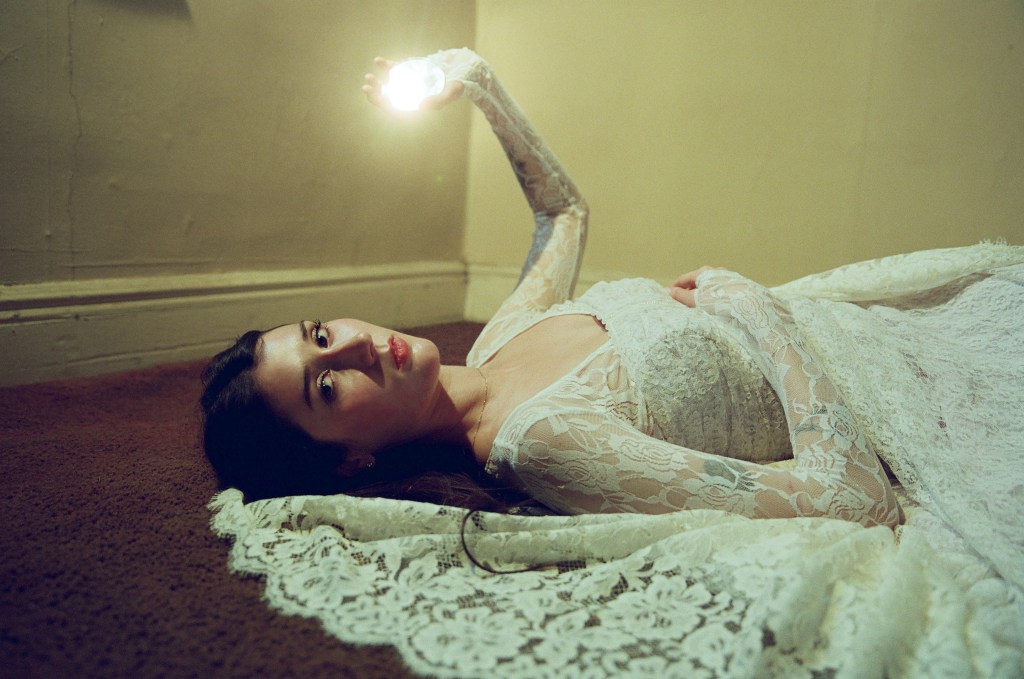
That depth that offers an almost macabre emotional pull became a north star for her when creating the record. “If anything, I was trying to evoke a similar emotion of [release],” she explains. “And not in all of the songs, but I wanted that like kind of relentless intensity.”
The word relentless feels like the record’s key. The album doesn’t meander or overstay its welcome. It surges, announcing itself in a vibrant cinematic display. Songs expand and contract like lungs filling with ocean air, harmonies cresting and dissolving in waves. For Litsa, that world is less about imitation and more about immersion.
“It all kind of plays into just an emotional world where listening to [Rachmaninoff’s] music or any of the other inspirations put me in this emotional world,” she says. “And then a lot of the songs were inspired out of me being transported into that emotional world, but not through music, but through an experience.”
Experience becomes sound. Sound becomes excavation.
“A song is kind of born out of that world. How do I communicate exactly what I’m feeling through harmony, through lyrics? I find that it’s just easier to do, express to myself that way sometimes.”
That instinct to follow feeling before structure defines her process. “I think that sometimes you don’t even understand why you want to say something,” she says. “Or what it is you’re trying to say. Or why a certain chord comes or the song changes meters,” she says. “But, t’s a lot about following the intuition and following where your heart wants to go.”
The heart, for Litsa, often speaks in fragments before it speaks in full songs.
“A lot of them just kind of, there’s a sound or like a melody that kind of appears in my head,” she says. “I’d say most of the lyrics are written in like an emotional turmoil. Because I find it’s the only way I feel like I can express myself sometimes.”
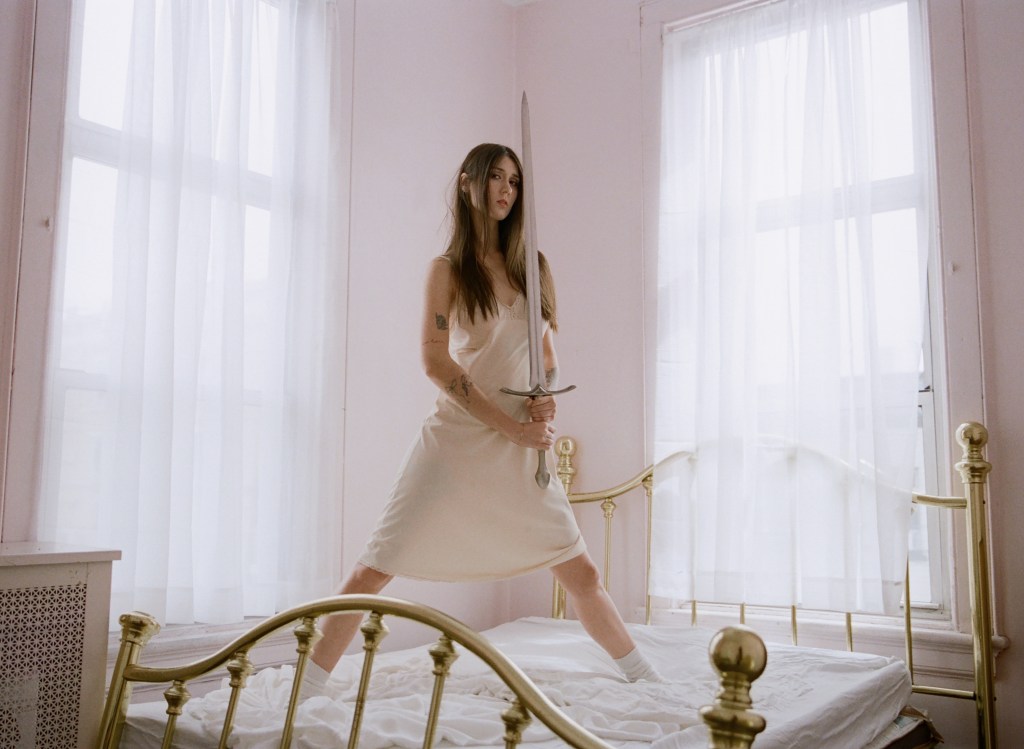
In terms of how the actual album came together, her process matches the theme of staying within a trance of emotional intensity. As she puts it, some tracks arrived in flashes, while others resisted her for years.
“There’s probably two songs that I really felt were hard to write, and those were ‘1117’ and ‘Darker,’” she says. “Especially ‘Darker.’ I really didn’t want to put it on the album. I never really wanted to finish it.”
Perhaps that’s because the composition was a multi-year process. She began to write “Darker” in 2019. It would take nearly five years, and a shift in perspective, to bring it home.
“It took me 5 years to finish that and to really integrate the experience of what that song’s about, which I still don’t really fully understand it.” Though, that incomplete understanding is not a flaw. It’s the point. “A big part of these more heady topics to me that I cling to is a sense of fate and a sense of meaning and assigned meaning,” she says. “Looking at what things in my life I assign meaning to, and what things in my life that I find myself reliving over and over again.”
Her understanding of patterns, recurrence, and synchronicity actually came following a time studying Jungian psychology, and seeing a Jungian analyst. And while doing so deeply helped her on a personal level, she naturally found herself incorporating those themes into her music.
“For a lot of the songs on the album, I’m trying to grasp at this pattern or condition that happens over and over again and why,” she explains. “Just trying to understand myself, I think, in the world around me. Which is really hard and very scary sometimes. But I feel like when I write the songs, it’s always, I’m trying to do that.”
In that way, Drasticism feels less like a collection of tracks and more like a document of self-interrogation. Litsa doesn’t position herself above the listener. She positions herself mid-question.
“It’s weird,” she says. “It’s like, what about me makes me feel like I need to write music to express how I feel?” she asks. “Because a lot of people don’t feel that they need to do that. But I think there’s something that connects musicians.”And yet, once the song exists, it no longer belongs to her alone. “The song is from me, but it doesn’t really belong to me, anymore. It belongs to the people who listen to it and attach their own sense of meaning and their own story to it.” That release might be the most drastic act of all.
When asked what she hopes listeners take from the record, her answer is disarmingly honest.
“I honestly don’t care. I feel like I am just so glad that I made it,” she says. “It feels so crazy to let go of it at this point.” She doesn’t seek strategic packaging or virality. She doesn’t see the need for finding an algorithmic hook that’s engineered for ten-second long attention spans.
“When I was making the album, I felt very hedonistic,” she confesses. “I was just like, ‘Everything I did, all the choices I made on it were purely to gratify myself. If I thought along the way of like, ‘Oh, how can I make this music so that people will like it?’ then I dilute my own expression.”
In a landscape increasingly shaped by speed and commodification, that stance feels almost radical.
“In the world of TikTok where everything has to be like a ten second sound bite, or a hook. It’s just a little bit boring,” she says. “I think at its best, music is not commercial at all. It’s emotional.”
For Litsa, songwriting is less about constructing something new and more about uncovering something that was already there, albeit, buried, waiting, humming.
“I think letting my voice lead me places,” she says. “What do I want to sing?”
On Drasticism, she follows that question all the way down, and invites us to listen closely enough to follow it too.
Drasticism is out now. More information on Bella Litsa here.

 Culture Cabinet
Leave a comment