

One of my favorite films concerns a fictional meeting between two historical figures who lived at the same time, but may not have ever met. Historical records do not contain any proof that the pair ever interacted in person in their lifetimes, but there’s also no conclusive evidence that they did not. In Mary Queen of Scots, Josie Rourke imagined what Elizabeth I of England and Mary Queen of Scots might have said to each other if they came face to face.
Freud’s Last Session similarly imagines a long conversation between C.S. Lewis and Sigmund Freud. Though less directly at war than Elizabeth and Mary, they were engaged in different sides of an intellectual battle with Freud’s stern atheism and Lewis’s Christian beliefs separating their schools of thought. Their conversation occurs in September 1939, just as England is officially going to war against Hitler’s Germany.
For anyone unaware, Lewis was a scholar of English literature at both Oxford and Cambridge, as well as an Anglican theologian after his conversion to Christianity at the age of 32 years old. He’s now best known as the author of the Chronicles of Narnia series, and the close friend of J.R.R. Tolkein. On the other hand, Freud was an Austrian neurologist, credited with the founding of psychoanalysis. Both in his time and today, his theories are seen as perhaps overly focusing on the sexual (he essentially invented the idea of women having “daddy issues”), but his discoveries are still vital to the development of the field.

As the film tells us at its conclusion, it is true that Freud supposedly met with an unspecified Oxford don just before his death. It’s possible that it was Lewis, but unlikely that we’ll ever know. This allowed author Armand Nicholi to take liberties in his book, The Question of God, and imagine that it was Lewis who had a long discussion with Freud shortly before he committed suicide, due to the pain he was in from oral cancer. Mark St. Germain adapted the book into a play and then into the film script, which was directed by Matthew Brown.
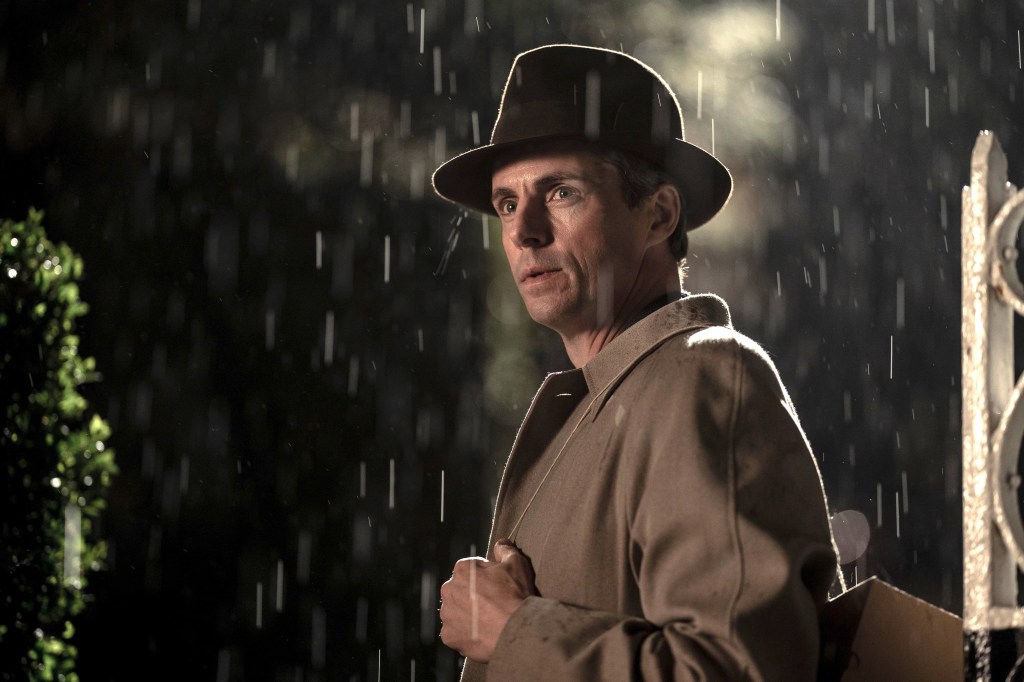
The two men (expertly played by Anthony Hopkins and Matthew Goode) discuss their belief, or lack of belief in God, sexuality, relationships, and Lewis’s friendship with Tolkein. Hopkins is perfectly suited to the flippantly irreverent Freud, who knows he is in the last days of his life, as he suffers from the cancer that is ravaging his mouth. Goode impressively matches him, particularly in the scenes that deal with his PTSD from fighting in World War I.
Less effective are the cutaway scenes of flashbacks to other events in Freud and Lewis’s lives. The film also tracks Freud’s daughter, Anna, (Liv Lisa Fries) who was a talented psychotherapist herself while taking care of her aging father who depended on her potentially too much. This part of the film is perhaps the most frustrating as it attempts to address her (likely) romantic relationship with Dorothy Burlingham (Jodi Balfour) and her attempt to be taken seriously in a field that looks down upon her both as a woman and as Freud’s daughter.
Despite taking the time to lay out Anna’s problems, the film doesn’t dive deeply enough into them for these scenes to be meaningful. In fact, that’s the real issue with the movie as a whole – it never really gets deep enough into any of the character’s lives or the issues Freud and Lewis are debating to go beyond surface-level. For two men with such fascinating lives, and such fascinating conflicting ideologies, you’d expect the script to do more to approach them with nuance.
“At my age, I don’t know what I think anymore,” Freud tells Lewis at one point, but it feels more like a metaphor for the film. The messy chronology and attempt to take on too much of each man’s life leaves the audience muddled and unsure what they’re meant to take away from it. Are we meant to believe that Lewis drew some of the inspiration for the Chronicles of Narnia from this day? Are we meant to see that Freud’s views continued to evolve through to the end of his life, despite him rigidly not budging from his anti-religion stance?
It’s a shame to take such an interesting imagined meeting between two of the most interesting figures of the early twentieth-century and squander it by not delving deeply enough into either of their lives or their thoughts. Despite very solid performances from Hopkins and Goode, Freud’s Last Session is completely underwhelming.




 Culture Cabinet
Leave a reply to Brenda Richardson Cancel reply