
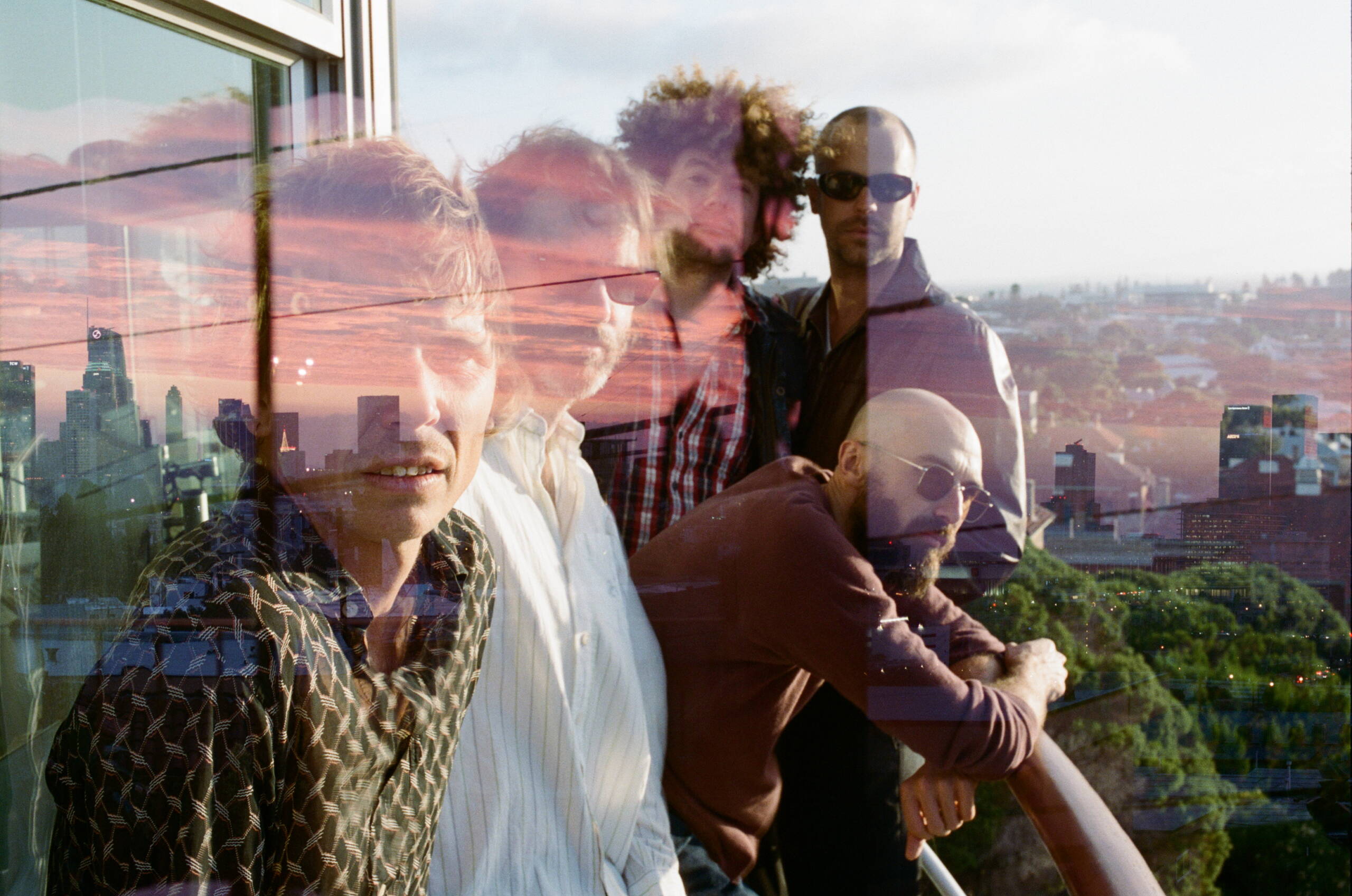
I have had the distinct pleasure of witnessing Pond live. Standing in the photo pit at Forest Hills Stadium last month, I watched frontman Nick Allbrook spend forty-five minutes warming up the crowd before headliner Djo’s set by moving around the stage with a sort of McJagger-esque spark. He took clear joy in electrifying, if not shocking the audience by never standing still for more than a few seconds, and even swinging the mic cord around his neck. “He was stressing me out,” my friend in the stands texted me afterward (though, she meant it as a compliment).
That electric charge runs through Terrestrials, Pond’s eleventh studio album that came out earlier this year, but to simply harp on the album’s velocity would be a disservice. Hidden underneath each track’s need for speed sits a more contemplative idea that music can still bring people together, even when almost everything else seems determined to pull them apart. The first illustration of this notion that he points to is Dolly Parton. “I really want to go to a Dolly Parton gig,” he says when I ask what hope looks like in the modern age. “I just think that would be the most beautiful, enormous cross section of people, you know? Every person in the world would go to a Dolly thing.”
It’s a funny and maybe unconventional way of phrasing things, but it’s still sincere and rooted in a love of human connection. Which, I learn throughout our conversation, is a pretty apt description of Allbrook himself. He views music as the lynchpin that can hold a divided world together. “Art and music [are] something that people traditionally use to gather together and signify that we’re all in the same key and same rhythm,” he says. “By being in the same key and same rhythm, it’s what we’ve always used to kind of extend an olive branch across.”

Terrestrials was made in the band’s home of Western Australia, a place where the environmental consequences of resource extraction are difficult to separate from daily life. Songs like “Casuarina,” “Two Hands” and “Sky Works” interweave that landscape, and its pitfalls, into their lyrics. There’s talk of mining, industry, fire and dust throughout, but the record is ultimately more interested in exploring what happens to people living underneath the weight of oppressive systems.
“The government is completely captured by the mineral resource extraction industry,” Allbrook explains. “It’s everywhere, and so it’s so existential. The presence of these sort of demigods who literally run public life, it’s West Australian life.”
It would be easy for a record made in response to something so grim to collapse under its own seriousness or turn into some display of performative activism. But, that simply isn’t the way of Pond (which, aside from Allbrook is composed of Jay Watson, Joe Ryan, Jamie Terry, and James Ireland). The band may be quick to point out the troubles that Western Australia, if not our greater world, face on a daily basis, but there’s still an underlying theme of hope. A suggestion that maybe one day the world will wake up. But, in the meantime, we can sit in the unifying threads of art.
“Greed and cynicism and all this stuff is so much less permanent than dancing and singing and getting pissed together,” Allbrook says. “This is something that’s literally baked into our evolutionary being. Being a greedy fuckhead mining demagogue isn’t baked into our DNA. It’s just a couple of dickheads who’ve sort of gone off the rails.”
That natural inclination towards movement found its way into the making of Terrestrials, too. For the first time, Pond used a permanent studio set up where they could leave their equipment assembled and return whenever they felt like it. Allbrook was working as a gardener and would stop by after work, sometimes alone, sometimes with other members of the band. And even if the other side of that process contained the band’s eleventh studio album, the new approach felt like a bit of an upgrade for Allbrook. “It was almost like the difference between camping and having a house,” he says.
Instead of turning to the traditional ritual of packing up equipment, booking rehearsal rooms, trying to force creativity into a designated window of time, with the new setup, there was room for songs to be unfinished. And, in turn, a more laid back process that Allbrook says ultimately served the record. “I’d pop down after work, have a shower, and then go and make gum or whatever,” he says. “And it was just so nice being able to kind of just put in a couple of hours. Put in an hour. Should we go for an hour?”
Allowing the songs to not be so set in stone made for recording sessions that enabled the band to actually take stock of what they were creating. “You could sort of watch songs develop in front of you a bit more,” Allbrook says, “instead of kind of having to nut them out at home.”
But, that’s not to say that they went in without any rules. In fact, I can’t help but note how strangely specific they are. No fuzz pedal. No ballads. No “Pink Floyd shit.” The restrictions sound severe until Allbrook explains the point: they were there to keep Pond from disappearing down every possible musical rabbit hole.


“They’re dumb rules,” he says. “But we did just want [the album] to be a bit faster and more energetic, and just different. Sometimes it’s really nice just to restrict yourself.”
The result is a record that rarely sits still. Even when Terrestrials looks toward ecological collapse, political corruption, or the uncomfortable question of whether humanity will save itself when given the chance, the songs manage keep a lively pulse. There is dread here, certainly, but there is also sweat and electrifying energy. The record seems to understand that despair is a poor substitute for being alive.
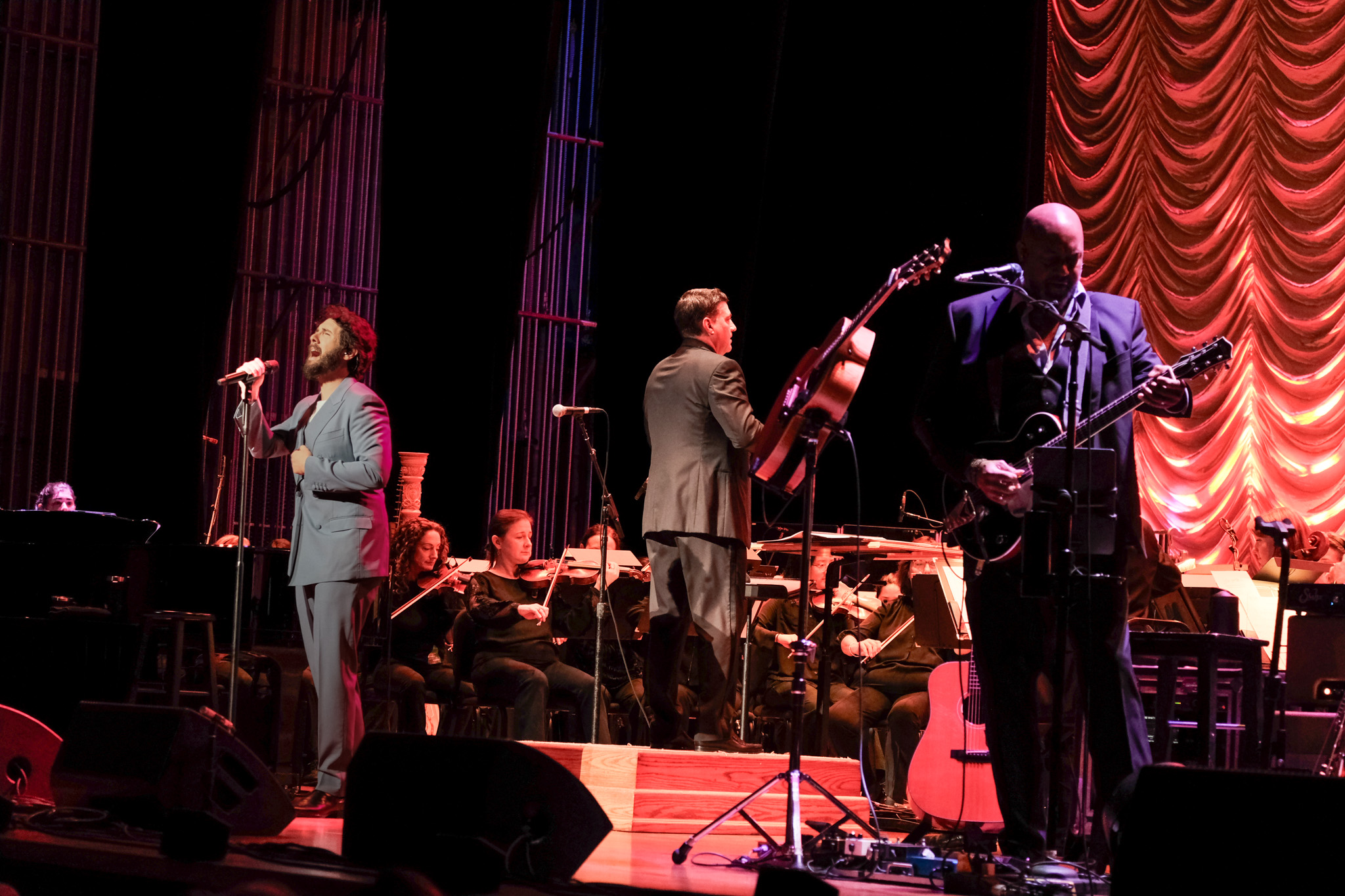
Pond took that energy across North America while touring as the supporting act for Djo’s Summer Tour, playing to crowds who were often encountering the band for the first time.
“It was super cool having the opportunity to play in front of vast amounts of young Americans, which I don’t think we would have got without supporting Djo,” Allbrook says. “I get a real kick out of seeing people be sort of confused or horrified in front of me. It sort of ignites something.”
At Forest Hills, I could see what he meant. Pond’s music has a particular talent for making one feel that surrendering to the absurdity is the only reasonable response. The guitars surge. Allbrook moves as though the laws of stagecraft are merely suggestions. Somewhere in the crowd, people who likely arrive as strangers begin moving together.


He had seen the same thing at a Tame Impala (of which he was previously a touring member) show shortly before our conversation. Thousands of people, strangers to one another, packed into a stadium and dancing beneath a wash of lights and lasers, underscored by the pulsating rhythms of Kevin Parker’s musical talent.
“This is what we have to do now,” Allbrook says of the experience. “We need to do togetherness on an industrial scale.”
The phrase may sound a bit like wishful thinking, but when you zero in, it’s actually quite simple. Experiencing live music is nothing new. It’s been embedded in culture for centuries. At any given time, we gather in stadiums, in clubs, in lines for Record Store Day releases or to get a good spot in the General Admission pit. And in doing so, we stand shoulder to shoulder with people whose names we may never know, but even so, are not strangers for a couple hours. We bask in the electricity that hearing live music naturally creates. We’re reminded of an artist’s personhood when they mess up on stage. We get scared when a singer wraps a microphone cable around his neck. Allbrook thinks there is value in the imperfection.
“There’s sort of a groundswell of resistance against the sanitation of music making with streaming services and AI and stuff like that,” he says. “It’s pretty quick when you think about it. I reckon people like it. It’s like a very fast, immediate kind of, ‘Oh, this is fun,’ and then pretty soon afterwards, it’s like, ‘Actually I kind of miss buying CDs and having a thing to love, and going to gigs and seeing people fuck up on stage.’”
He laughs when I bring up my friend’s text from Forest Hills. “Being stressed out about someone wrapping a mic cable around their neck,” he says. “I think people are pretty [keen for that].”
Maybe that is what Terrestrials is ultimately reaching for. It knows that it couldn’t possibly offer an answer to the world’s problems, but it still can recognize the value in still remaining engaged, and using music as a unifier, not a divider. Allbrook hopes that, years from now, listeners will hear the record as a relic of problems that no longer exist.
“It’ll be great if people look back one day and go like, ‘Oh yeah, wow, people used to write music about this. Glad we’ve figured it all out.’”
He mentions that the “it” to be figured out includes fossil fuels, resistance to renewable energy, Indigenous youth incarceration, veteran suicide. The list is grim. But the wish behind it isn’t. And if you think about it, it’s actually quite moving to hope that one day your own album will become obsolete.
For now, though, the problems remain. But so does the music. And if Allbrook is right, there is still something worth protecting in the strange, sweaty ritual of gathering together, turning the volume up, and letting a room full of strangers become, at least for a little while, a single thing.
Article photos by Lex Williams / Header photo by Kristofski


Leave a Reply