
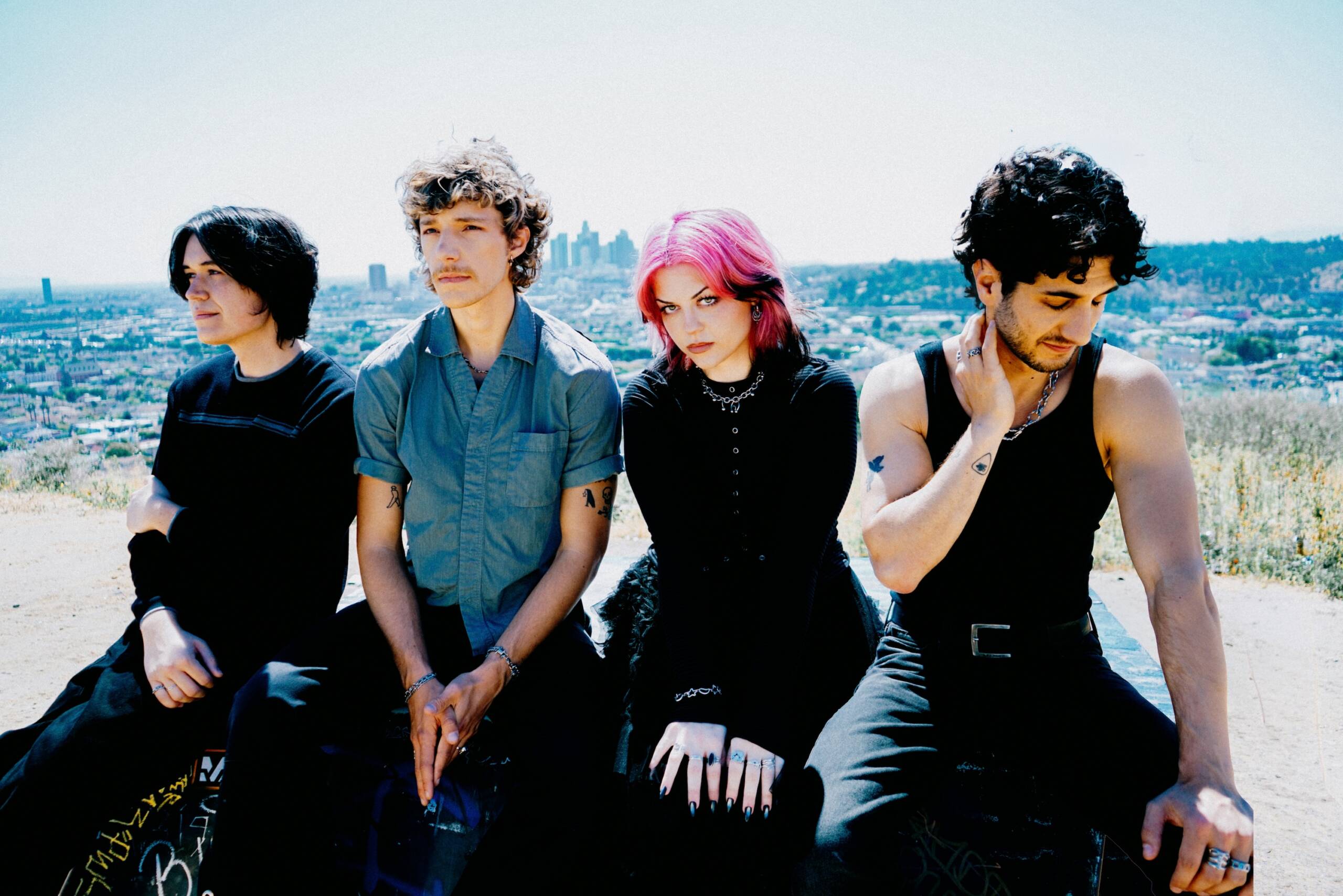
Things are going pretty well for wilt. For one thing, the Los Angeles rock band recently released their debut album, when no one’s watching. For another, they just wrapped up a North American tour, and are poised to embark on their European tour in support of the album in just a few months. And, arguably best of all, they find themselves happy to connect with an increasingly growing fan base.
But, no experience is ever completely positive or negative, and even exponential success has its own quiet moments, where feelings like self doubt and confusion can creep in when the noise has died down. It’s a fitting thing to meditate on, given that their new album, as its title suggests, explores the messier side of growing up and figuring yourself out. While when no one’s watching may be their debut, the band has been making music together for years. Within the last year, they’ve found that their music has found a wider audience, their social media presence has brought new listeners into their orbit (though not always in the way they expect or even want). And, to top it all off, after years of chipping away at the independent music scene, it feels like they’ve finally hit the breakout moment they’ve been waiting for. Still, the feelings that make their songs resonate have a way of following them home.
“When no one’s watching was kind of like a direct feeling that we had for a while when our social media was doing really well and it didn’t feel like people actually cared about our music,” front woman Chelsea Rifkin explains from the back of the band’s tour van, en route to their next tour stop. “It was this weird juxtaposition for a while where we had a lot of followers who were just fans of the videos we were posting, and it was all about getting them to listen to more music. Now it finally feels like they are.”
That juxtaposition sits front and center of when no one’s watching. It openly explores the excitement of finding an audience, of playing shows and watching people connect with songs that once existed only between four bandmates in a room. But, it also holds space for the quieter question of what happens when the attention fades and you are left alone with just yourself, and when praises from strangers is suddenly replaced with the voice inside your head. For wilt, those experiences have become increasingly difficult to separate. The band has spent years trying to reach people through their music, and now that more people are listening, they are still figuring out what it means to be heard.
Hence, the album title. By definition, it speaks to that feeling of battling two seemingly paradoxical realities. From the outside, things can look like they are falling into place, even if privately, the same insecurities, doubts, and emotional struggles that one may have previously fought off are still there, just waiting for the noise to die down. It is a familiar contradiction, especially for anyone (particularly in the creative space) who has ever worked toward something for years only to find that reaching it does not automatically smooth everything over or erase any sense of doubt.
For wilt, the process of making this album became a way to work through some of those contradictions together. For instance, Rifkin, along with guitarists Aaron Liebman and Andy Vance, and drummer Dan Bermudez approached this record as a much more collaborative effort than before. Rather than having Rifkin write lyrics and the other three members write instrumentals, the band found themselves writing songs together in the same room and allowing their individual ideas to develop into something that felt representative of the band as a whole.
Vance points to “dent” as a good example of what the change in songwriting approach produced. “It’s one of the earlier songs we wrote for the album, and one that we just all had a lot of collaborative effort into,” Rifkin adds. “There’s different parts there that we all kind of have a say in. It really does feel like an accumulation of all of our different influences, feelings.”
The record’s final song, “suffocate,” offered another version of that experience. The band had written it only a few weeks before recording the album, working through the arrangements together and finding the final cut of the song in real time. Vance remembers the process as a particularly exciting one, with the members trading ideas and working out the instrumental parts as a group. After years of making music in a more piecemeal fashion, there was something satisfying about hearing the songs take shape through that kind of shared momentum.

“‘Suffocate’ was so cool because [we wrote it] just a couple weeks before it was recorded, before Carlos looked at it, and we just locked in for a week,” Vance says. “We all workshopped all the parts together: bass, guitar, drums, and vocals. It was just all that experience of doing things together when we first started out.”
That change in approach also brought the band closer to the music that first inspired them. Wilt’s earlier releases explored lighter, more indie-pop territory (a cover of t.a.T.u’s “All the Things She Said” remains a staple on their live setlist). But, as the band progressed, the members found themselves moving between and experimenting with sounds and sonic aesthetics as they figured out what exactly they wanted the band to be, before eventually settling on the heavier, more guitar-driven music they had grown up loving. The new album gave them room to follow that instinct without second-guessing it.
Liebman remembers how easily the band initially moved away from those original roots and more towards their own distinctive sound. “Andrew [used to] make these indie-pop demos, and Chelsea would just top-line them, and then we were like, ‘Wait, this sounds great. Can we not just put this out?’” he says. “But our first song that we ever put out could be on this album. It totally could fit sonically on the thing that we’re about to release, except for the fact that it wasn’t recorded in a big studio.” The band’s sound may have evolved, but the instincts that shaped its earliest music have always remained. Revisiting those influences meant reconnecting with the parts of themselves that had drawn them to making music in the first place, rather than trying to guess which direction might be the most lucrative from a more surface level view.
For Rifkin, that connection is especially personal. Her late father introduced her to much of the music that continues to shape her songwriting, and his influence runs through the record in ways that extend beyond a particular guitar tone or melodic reference. While working on the album, she returned to a playlist he had made before his death, titled “Brady’s Great Big Punky Parade of Hits.” Filled with songs by Dead Kennedys, Bad Religion, The Damned, Screeching Weasel, Minor Threat, and Descendents, it became an unexpected point of connection between her past and the music she was making in the present.
“It’s a lot of classic punk, which I think definitely influenced a lot of the things I was writing about, with just being upset with the world, upset with myself,” Rifkin says of the playlist. “It definitely manifests in some of our grungy songs. He was also super into ’90s rock and ’90s grunge, which I’ve always been really into. My voice kind of took a page out of his book with it, but bands like Nirvana, Radiohead, and Weezer are my three favorite bands that I grew up with and are very much in my music taste thanks to him.”
And while that playlist was crucial to helping shape the band’s sound, working with producer Carlos de la Garza helped the band bring loose themes into sharper focus. After spending months preparing the songs together and focusing on their more collaborative approach to songwriting, wilt entered the studio with a clearer sense of what they wanted the album to sound like. Rather than radically changing their direction, de la Garza helped them realize it, offering a trusted outside perspective while allowing the band’s personality to remain intact.
“Honestly, I would say he just really elevated everything,” Rifkin says. “He really got our vision and was really excited about it, just as excited as we were, and I think because of that, we were able to really get exactly what we wanted, what we set out for. But he definitely made some changes to certain songs or certain structures that I think definitely made them stronger.”
For Liebman, having someone else involved in the process the band the value in having another opinion in the mix. For a band that had, for so long, managed itself entirely on its own, De la Garza helped them learn how to step back, take their feet off the gas a bit, and eventually trust someone else’s opinion on their art. De la Garza gave them a reliable sounding board, someone whose opinion they respected enough to break a tie when the four of them could not agree.
The result is an album that seamlessly shifts between the different sides of wilt’s identity. The guitars can be heavy and abrasive before opening into something melodic and immediate. The songs are energetic without losing sight of the emotions underneath them, and the lyrics often find their way into conversations that aren’t allowed to lay it all bare on the table.
That balance is particularly evident in “bundy,” a song that had already become a fan favorite long before it found a place on the album. Written in early 2024, it had been part of the band’s live set pretty much since its inception, and returning to it for the record gave the members an opportunity to hear it with a more distant approach. And even if the band worried that they had become a bit rusty in playing it again, its place on the album became clear when they returned to it. “The chorus that Chelsea wrote is just so strong and memorable that there was no way it wasn’t going to make it into the record,” he says, noting he also loves the effect that the song tends to have on live audiences. “It’s the perfect BPM for jumping. You don’t have to jump too high to match the tempo of the song.”

As the band’s audience has grown, the relationship between the music and the people listening to it has become more tangible. Social media helped introduce wilt to a much wider audience, but playing live has allowed the members to see what those connections look like in real life. Rifkin says that experience has helped the band feel more secure in the knowledge that their songs are reaching people. Liebman describes a relationship with fans that remains unusually open. The band members spend time around venues before and after shows, talking with people who come out to see them. Rather than maintaining too much distance, they have allowed those interactions to become part of what wilt is.
“There’s not really a parasocial relationship [with our fans]. It’s just social,” Liebman says. “We’re not very mysterious. We’re pretty easy to find. We don’t really hide, not that we really could, even at a lot of these venues, but we’re always floating throughout the venue. People will come and just hang out. We’ve built this relationship with our fans that’s really perceivable. We’re kind of open.” He recognizes that this could change as the band continues to grow, but for now, the openness feels natural. The audience is made up of people who care about the music, and the band wants to meet them where they are. “For all of us, it’s just our dreams coming true,” he says. “So why wouldn’t we want to talk to the people that fuck with our music?”
There’s an uncommon amount of generosity in that outlook, especially alongside an album so concerned with the private feelings that can persist beneath outward success. The band wants to be available to the people who find meaning in their songs, while also recognizing that making music requires space to be alone.
Vance sees those two sides as something the band will continue trying to reconcile, likely for the rest of their career. “The contrast between those private feelings and the public wholeheartedness is something that we always want to continue to merge,” he says. “To really get to the level that we want to be at, it has to be effortless, and I think it becomes effortless when you can find the perfect middle ground between your private needs. You need to be off, and you need to be an artist and be a symbol for a chance of the emotions that they’re going through, and be a source of acceptability and resonance.”
It may be an ongoing process, and one that when no one’s watching seems willing to leave unresolved. The album understands that success can be exciting and disorienting at the same time, that being surrounded by people does not necessarily make someone feel less alone, and that the things people struggle with privately do not always disappear when life begins to look different from the outside.
For now, though, wilt seem content to keep showing up, playing their songs, and finding out what happens when the people on the other side of the screen become people standing in front of them. And while the answer to what happens “when no one’s watching” may still be evolving for the band, they’re learning that they don’t necessarily need to have all the answers.
when no one’s watching is out now.

Leave a Reply