
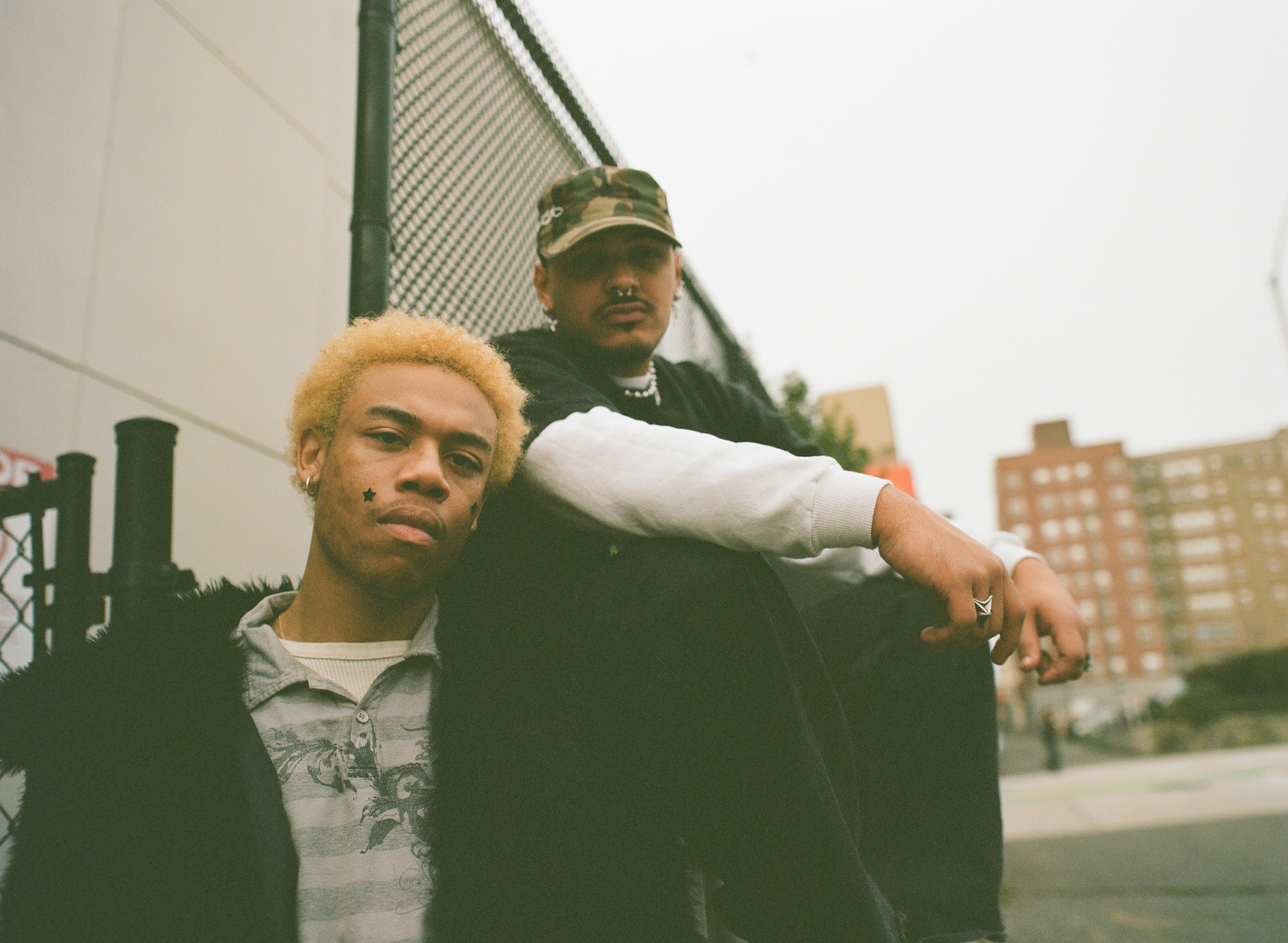
Despite the fact that Casi‘s self-titled debut album crashes headfirst between hip-hop, emo, hardcore, metal, and indie rock, the record’s greatest strength is not its willingness to blur genre lines. It’s the fact that beneath all of the distortion, booming drums, and rapid-fire transitions sits something much simpler: a deep friendship that has been quietly developing for more than a decade.
When I sit down with Eli Edwardsand Xayvien “Xay” Young, the duo behind Casi, the ease between them is immediately apparent, to the point where itt feels less like interviewing a band and more like listening to two lifelong friends recount a shared history.
That history stretches back to childhood in Spanaway, Washington, where the pair first met (after Edwards’ mother gave him $20 and instructions to “find a friend”), and quickly became inseparable. Years later, life would pull them in different directions. Edwards eventually relocated to Los Angeles while Young remained in Washington. Yet even with hundreds of miles between them, the creative partnership persisted, until Young eventually relocated to Los Angeles as well.
Those periods of reunion ended up shaping the DNA of Casi’s debut album, out tomorrow.
Though Casi is the duo’s debut album, most of the songs were years in the making, and when it came time to craft the album, some of those tracks seemed destined to make the final cut.”We had select tracks that were the ones [we eventually put on the album],” Edwards says. “I think early on, ‘Jumper’ was one of the first ones. ‘Intrusive Thoughts’ and ‘Human Stereotype’ were the first couple tracks that came out of random writing sessions, and I think we built the record around those.”

What emerged from those sessions is an album that feels difficult to categorize, largely because categorization never seems to have been the goal. Songs frequently shift shape. A track might begin with rap verses before giving way to guitars that feel lifted from an early-2000s emo record. Elsewhere, hardcore influences surface unexpectedly before dissolving back into melody.
For Young, some of that genre fluidity can be traced back to the realities of creating music while living apart.
“I think a big part of the genre-bending was the fact that Eli was in LA and I was in Washington,” Young says. “Whenever I would see him or he would come down and crash at my house for five days, that whole five days it’s like we’re working on something. It’s like, ‘Bro, I’ve been listening to this.’ It’s like, ‘Oh shit, bro, I’ve been listening to this.’ Later in the night we’re creating something. We have all these fresh ideas in our head and these fresh sounds and textures.”
Listening to the album, that sense of spontaneity is easy to hear. The songs rarely feel concerned with fitting neatly into a particular lane. Instead, they follow whatever idea feels most exciting in the moment. “A lot of it is on accident,” Edwards says of the duo’s disinterest in remaining in one particular genre. “It’s not like, ‘Oh, we’re gonna try to make a hardcore song that sounds like a rap song.’ It’s like, we make rap, so we’re gonna put the sauce that we already have in the container onto the stuff that we’re trying out.”
The result is a record that somehow manages to feel expansive without becoming disjointed. Even when the influences shift, there is a common thread holding everything together. Part of that comes from the fact that the album reflects two people exploring every corner of their musical interests at once.”I feel like the first most important part of starting a project is the DNA,” Edwards says. “Once you establish what the ingredients can be in this record, it’s off to the races.”
Of course, having a shared creative language only works if both people trust each other enough to use it. Throughout our conversation, both artists repeatedly return to the same theme: the absence of ego.
“I think our relationship helps in the sense that there’s no ego when we’re working on something,” Edwards explains. “There’s never a control thing. It’s never like, ‘I have to prove this’ or ‘I have to prove that.’ It’s just two people existing simultaneously with the same goal.”
That trust becomes especially important when creating music that is so collaborative by nature. Hooks get reassigned. Verses get rewritten. Ideas are challenged. Yet because the foundation of the partnership predates the band itself, those conversations never seem to become personal, which is attributed to Edwards and Young’s long standing history. “When we say we’ve been working together since we were kids, we were making some of the worst music you’ve ever heard together too,” Edwards says with a laugh. “We’ve seen each other at our best and our worst.”
The pair also aren’t interested in presenting themselves as self-made geniuses. While much of the album was built by Edwards and Young, they readily credit a small circle of collaborators who helped bring the project across the finish line. Friends contributed additional drums, guitars, mixing, and mastering work that elevated songs they already believed in.”We know we got the components,” Edwards says. “But we really wanted to make it high-definition.”
That attention to detail is apparent throughout the album. Songs like “Jumper” arrive with enough force to feel tailor-made for a packed venue, while tracks such as “Substance” reveal a more melodic side of the duo. “I’m Hungover and Went to Church” captures both impulses at once, pairing ambition and vulnerability with the restless energy that runs through much of the record.
Even the sequencing of the albumwas approached carefully. Though Edwards says the tracklist came together more easily than previous projects, the duo still spent considerable time thinking about how listeners would move through the album.
“We did spend a good amount of time trying to make it feel like a roller coaster ride,” he says. “We both love putting together setlists for the same reason. You want to control the energy.”
That description feels particularly fitting. Casi plays like a roller coaster in the best sense of the phrase. It is unpredictable without feeling directionless. Every turn feels earned, even when it catches you off guard.
It’s obvious that Casi is made up of two artists who are hungry to create, eager to share their art, and hopeful for the impact that their music will have on the industry. But when asked what they hope listeners will take away from their debut album, their answers tie back to their origin story.

“I hope they see just two kids from Spanaway showing that you could do it,” Edwards says. “No matter what. If you got FL Studio, you got Logic, you got GarageBand, you could do it. You could live in a different state than your homie. If y’all just locked in, you could do it.”
Young’s answer is similarly rooted in inspiration.”I want people to hear this and be like, ‘Damn, let me start doing some things too. Let me start reaching in bags that I didn’t know I had.’”
In many ways, that ambition mirrors the album itself. Casi is a record built by two artists who stopped worrying about what lane they belonged in and started following their instincts instead. The result is a debut that feels fearless, willing to ask bigger questions, and ultimately stands as a strong debut from what will likely be a long discography in the years to come. More importantly, it feels like the work of two friends who still sound excited to be making music together.
And for a band whose entire foundation rests on that relationship, that may be the most important thing of all.
Casi is out June 19th via Carpark Records. Tickets for Casi on tour can be found here.


Leave a Reply