
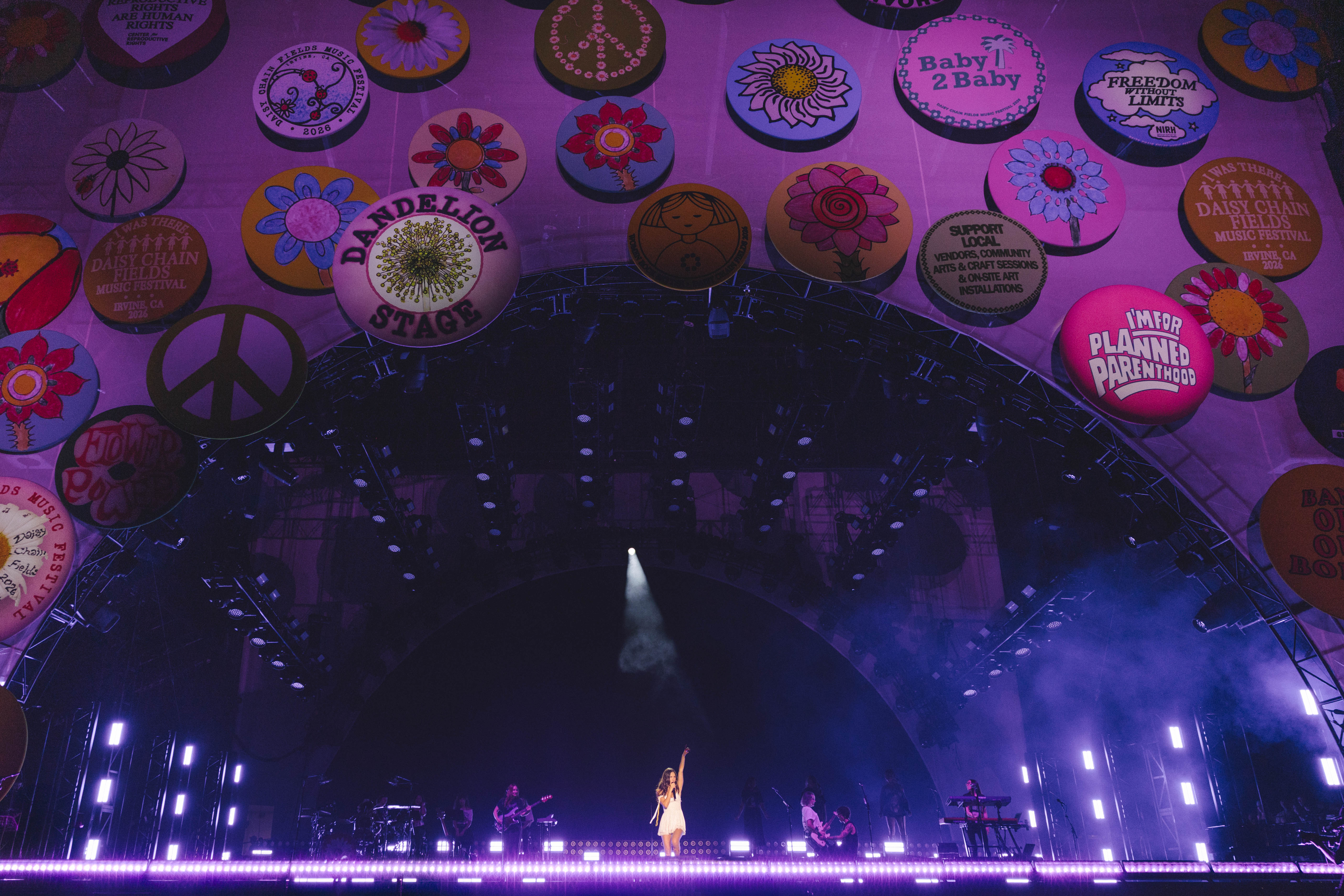
While Olivia Rodrigo is hitting the road for the start of her Unraveled Tour, the 23-year-old pop star presented her inaugural Daisy Chain Fields Festival in late August. Held in Irvine, California, on August 29, the festival featured a lineup of women-led acts, including headliners like Chappell Roan, Doechii, Mitski, and Santigold, as well as a set from Rodrigo that included guest appearances from Stevie Nicks, Alanis Morisette, and Sarah McLachlan.
While Daisy Chain Fields certainly brought in an eager social media following, especially coming off the heels of the release of Rodrigo’s third studio album, You Seem Pretty Sad For a Girl So In Love, the festival managed to break records in more ways than one. All festival acts agreed to appear without payment so all net proceeds could be donated to 10 different women-centered nonprofits. And between $10 million in ticket sales and a $10 million matching donation from Melinda French Gates, the net proceeds totaled to $20 million, equating to a $2 million donation per organization.
Among those organizations were Center for Reproductive Rights, a national organization that seeks to enforce legal protection for reproductive rights and health; Jhpiego, a Baltimore-based organization that focuses on providing healthcare to women in developing countries; FreeForm, a survivor-led organization that seeks to end gender-based violence; and John Hopkins Center for Indigenous Health, an organization that seeks to advance public health for Indigenous communities.
Culture Cabinet had the privilege of speaking with representatives from these organizations about the festival’s impact.
Each had high praise for Rodrigo, and spoke admirably of how someone so young was so eager to use her global platform to bring attention to worthy causes.
“Olivia has built an extraordinary community of young people who are engaged, passionate and want to make a difference in their communities and in the world. Music has the power to bring people together, and Daisy Chain Fields gave us a unique platform to meet this younger generation where they are, introduce them to Jhpiego’s mission, and hopefully inspire them to see the role they can play in advancing women’s health around the world,” said Dr. Allyson Bear, President and CEO of Jhpiego. “What I loved about Daisy Chain Fields was that it created a positive, supportive community around women and girls and gave people a chance to come together around issues they care about. That felt very aligned with our work.”
In each instance, it was apparent that Rodrigo had come to the table with an already robust knowledge of what each organization did and why she felt they were a good choice to be a Daisy Chain partner.
“We heard that Olivia had been talking about us and following us,” said Crystal Austin, Director of Communications and Co-Director of External Affairs for JH Center for Indigenous Health. “She learned more and more about our work, and that just really floored us. When we got the chance to speak with us, she said, ‘I’ve learned so much about your work.’ I was incredibly moved by that. I felt very honored that she knew about us and chose to work with us for Daisy Chain Fields.”
But what started as a mere conversation around becoming a nonprofit partner for a music festival quickly grew into something much bigger. While fundraising efforts are to be expected in the nonprofit world, every representative I spoke with had an obvious sense of surprise, bewilderment, even, over how enthusiastic and interested festival attendees were in the work their organizations do. It almost felt as if the charitable efforts of the festival were just as, if not more, integral to the experience as the musical acts themselves.
“The music lineup was amazing, but I was so impressed and genuinely touched to feel how much interest and appreciation there was for the non-profit partners and our work,” said Dr. Bear. “We connected with so many new supporters who were genuinely interested in hearing about what Jhpiego does and how to get involved. That’s what I found so rewarding. Music created a connection and opened the door to a completely different conversation, one that so many people responded to.”
“Daisy Chain Fields gave us an incredible opportunity to reach people who might not have heard of the Center before,” said Madeline Halperin-Robinson, Director of Digital Communications at the Center for Reproductive Rights. “Living through such a turbulent political climate, it’s easy to feel powerless and overwhelmed. But this festival reminds us that we can accomplish so much when we band together across generations, backgrounds, and causes.”

Across my conversations with all four organizations, I quickly found some common threads: a tense political climate. Ongoing attacks on women’s and reproductive rights. A seemingly never- ending list of reasons why we as a general society should be concerned about the direction our world seems to be headed.
And yet, not a single conversation was bleak. Quite the opposite, really.
Because amidst all the gloom, there was an even more palpable feeling of hope and inspiration. While each representative gave Rodrigo her rightfully earned laurels, there was a tangible feeling of gratitude towards the festival attendees, and an infectious feeling of hope that even I, someone who didn’t attend the festival, could feel.
Almost as if this festival served as more than a simple music festival (Dr. Bear called it the ‘Woodstock of 2026’), or even just a safe space for women and girls to enjoy simply being women and girls, which in and of itself is important in this world. More importantly, though, Daisy Chain Fields seemed to also serve as both a mirror to where we are presently, and a glimpse of what’s to come. While it would be easy to give in to the infinite feeds of “doomscrolling,” Daisy Chain Fields proved that we are far from too late. That hope is certainly not lost.
Because in a time where one of the biggest names in pop would even feel compelled to create such a festival to help create a sense of solidarity during historically turbulent times, a chain reaction (pun intended) served as the true victory. While the demographic of Daisy Chain Fields attendees skewed younger, they proved that they were up to the task of taking a stance and enacting change.
“Two days after I got home from the festival, I got an email from a 14 year old girl, who had said that she had been aligned to enter the Daisy Chain Reaction tent, but was unable to get one of our pins,” recalls Ms. Austin. “She said, ‘Thank you for all the work you do. I’m really excited to learn more. I’ve been reading a bit about your work on your website, and you guys are doing an incredible job. If it’s okay, I’d love to get a pin to add to my bag.’ She felt very inspired and had such a purposeful and intentional way of learning about everything else that the festival stood for. I felt very proud to be able to know this truly meant something and did its job of reaching all audiences, old and young.”
“There are two moments that have stuck with me,” echoes Dr. Bear. “The first happened before I even arrived at the festival. I shared a car with a mother, aunt, and daughter who were also heading to the park. We started talking about why we were there, and I told them about Jhpiego. By the end of the ride, they had donated $30. It was a small moment, but it stayed with me. They heard about the work, connected with it, and decided to do something. That’s exactly the kind of connection you hope to create. The second was introducing Rachel Chinouriri on stage. When I said, ‘We believe that where you live should not determine if you live,’ the crowd roared. In that moment, I felt like we had the whole world on our side, and that we could do anything. It was joyful and unexpected.”
And, of course, there was the moment when the nonprofit partners learned just how much money had been raised for each organization. While the momentum and interest garnered over the course of the festival seemed to be the biggest and most meaningful takeaway, each organization was already able to tell me what the $2 million donation would mean for its work.
Ms. Halperin-Robinson of the Center for Reproductive Rights told me that the donation will be put towards furthering CRR’s mission to file lawsuits and advocate for laws to expand reproductive rights worldwide, as well as helping advance laws within the United States that protect the right to abortion pills.
“The support we have received from Daisy Chain Fields will help the Center keep up the fight against these attacks on reproductive freedom in the U.S. and beyond,” she said.

“We live in a world where 1 in 3 women and girls will be subjected to gender-based violence in their lifetime. Most people just accept gender-based violence as normal and to be expected. Olivia and Daisy Chain Fields have given a global stage to our message – we can end gender-based violence if we invest in survivors and every one of us does our part. This is a complex problem, but FreeFrom is solving it by giving survivors cash. No strings attached, just trust. At Daisy Chain Fields, thousands of people heard that a world free from gender-based violence isn’t a dream, there is a plan and there are solutions,” said Sonya Passi, founder and CEO of FreeFrom.
Ms. Austin with John Hopkins Center for Indigenous Health said that the donation will be put towards continuing the mission of providing public health based programs to Indigenous communities.
“In my Navajo language, we often utilize the world iiná, which means ‘like life.’ Sometimes it’s translated as just ‘life.’ But when you look at that word very closely, the first part of that word is ‘ii,’ which means ‘I,’ and ‘ná,’ which means, ‘for you.’ So, when you look at that word, it also means, to me, that I am living for more than just myself. I’m living for you, I’m living for my relatives, my community, my people, and everything else that’s around us. To the earth, to our winged relatives, to those that are in the water. And I think that speaks to the spirit of what the whole vision of the festival was. We should all take a step back and think, ‘What else can I do? What else can I do to make the world a better place?’”
The answer to that question is surprisingly simple: don’t let the momentum stop.

While the festival may be over (though, it was announced that it will return for a 2027 festival), the work is just beginning. In fact, every representative I spoke with had a call to action.
“Stay curious,” advised Dr. Bear. “Learn more about what Jhpiego does and why our work on women’s health matters. Talk to your friends about what you learned. Find an issue that matters to you and figure out how you can contribute, whether that’s through your time, your voice, or your generosity. You don’t have to be an expert to make a difference. You just have to care enough to start.”
“There are so many ways to get involved!” said Ms. Halperin-Robinson. “First, everyone can use our abortion laws map to learn more about their rights in home states, and whether their state loves them or loves them not when it comes to reproductive rights. We want everyone at the festival and beyond to learn their rights, use the Center as a resource to navigate this complex landscape of reproductive rights access, and share what they learn with their communities.
In your own communities, continue to talk about abortion because change happens by helping people understand what’s at stake. We also encourage those who can to fund the legal organizations that fight for these rights, because the fights aren’t going away.”
Because here’s the thing about daisies: they’re beautiful on their own, but they’re particularly special when made in a chain. And if the worldwide reaction to Olivia Rodrigo’s Daisy Chain Fields Festival is any indication of where this generation stands when it comes to enacting positive change in our world, it seems that we’re in for a particularly beautiful chain.
To learn more about the above organizations, as well as the other non-profit partners of Daisy Chain Fields Festival, click here.
Header photo by Emma Wannie, article photos courtesy of Daisy Chain Fields Festival on Instagram


Leave a Reply