

It’s 45 minutes before I’m meant to interview Karl Kuehn, the name behind moniker Gay Meat, and I am suddenly met with an alarming notification: Karl (Gay Meat) has joined the waiting room.
My mind begins to automatically race. Have I made a mistake? Did I get my schedule wrong? Has my time blindness struck yet again?
As I quickly hop onto the Zoom and let Kuehn into the meeting, I learn that I am not late. He is just habitually early. However, as we now find ourselves both early to the interview, I learn that this unexpected stretch of extra time is actually a gift, as it affords me the rare chance to get to know Kuehn a bit better before we dive into what I already know is going to be a somewhat heavy conversation. As we gush over our mutual love of Labubus, swap our favorite putt putt spots in Myrtle Beach (where we both spent many childhood summers), and admire the eclectic mix of tchotchkes that sit on our shelves, I gauge a sense of who he is.

He is disarmingly friendly, very easy to talk to, and has a sense of openness that can only come from someone who is comfortable with vulnerability without seeming like a martyr. Before we even formally begin the interview, I already feel like I can understand the connection between artist and art.
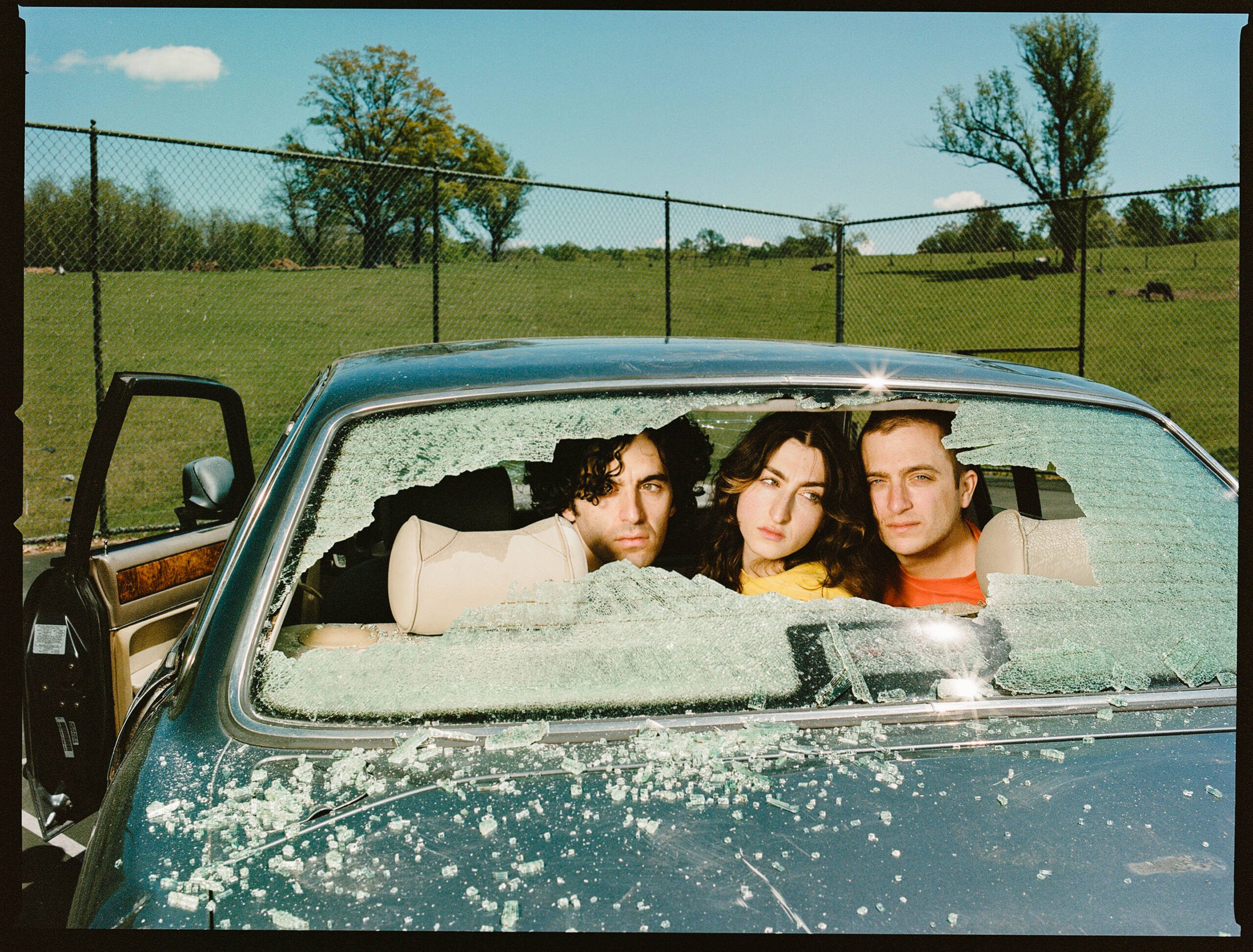
But now, the time for formalities has passed, and it’s time for us to get to the crux of why we’re here: to talk about Gay Meat’s debut album, Blue Water, which is out now.
Blue Water doesn’t feel like a clean cut album that prioritizes polished production. It feels weathered by real life and then carefully pieced back together, much like the life experiences of Kuehn himself. Across the album, he traces grief, caregiving, memory, absurdity, and survival with the kind of specificity that can only come from someone who has actually stood in the center of it.
When I ask how that period of his life eventually transformed into song, Kuehn doesn’t romanticize the process. Instead, he speaks plainly about the strange duality of caregiving, the way devotion and logistics often become tangled together.
“I always describe that feeling of kind of like you’re clocking in to provide emotionally for someone who cannot do that themselves,” he says. “You’re also clocking in to do actual business for someone who is incapacitated in that way. And I, as a human being, I just kind of struggle with that normally.”
He goes on to describe the bureaucratic surrealism that accompanied the emotional weight of it all.
“The minute my mom ended up in the hospital and she had been there for a minute, we’re talking to some of the healthcare workers there about trying to reorganize her insurance and then start paying for her medication. And I’m fully spending four hours a day on the phone with insurance trying to switch my mom’s plan. When I zoomed out, I was like, I don’t even have insurance.”
He laughs when he says it, but the humor only sharpens the truth underneath. Sometimes grief does not arrive looking cinematic or poetic. Sometimes it looks like hold music on the phone, paperwork, fluorescent lighting, and trying to make adult decisions while your world is actively collapsing.
“It just constantly made me feel like a Sim,” he adds. “But I am me. So of course, if my life has become a video game, I still want to win, and I still want to do well.”
There is something so quintessentially human in that statement: even when life becomes unrecognizable, some part of us still wants to do right by the people we love. For Kuehn, that became the guiding question of the era that would eventually shape Blue Water.

“I was truly just going every day, ‘What can I do to the best of my abilities today? How can I go to bed tonight, whether I’m in the hospital room with my mom or the nursing home with my mom, or if I’m rarely at home in my own bed, how can I go to bed tonight and know I did the best I possibly could?’”
That emotional honesty is what gives Blue Water its gravity. It is not interested in neat lessons or tidy redemption arcs. It is interested in the messier reality of trying.
Before Gay Meat, Kuehn spent years fronting Museum Mouth, and at the time everything changed, the band was gaining momentum. Looking back, he sees that chapter with both fondness and distance.
“With Museum Mouth, we were definitely at a career high, and it felt really good,” he says. “But I do think maybe more than it was obvious to my bandmates, all of that was really affecting me as a person just trying to navigate the world. It’s a very scary feeling when you feel like you’re standing on the ledge, and it’s like you could dive off and have success, or you could walk it back for any number of reasons.”
When his mother’s health crisis forced him home, that crossroads disappeared overnight. Still, he speaks less about losing momentum and more about gaining perspective.
“A lot of time away from being an active touring musician and playing the album cycle rigmarole has been really great for me,” he says. “Where I am now, I feel a lot more capable. There is no bitterness in his voice when he says this. If anything, there is gratitude for the person time shaped him into.
That perspective extends to the structure of Blue Water itself, an album that unfolds like chapters rather than disconnected songs. As a listener, it feels almost like overhearing a private conversation, sometimes with his mother, sometimes with himself, sometimes with the universe at large. Kuehn tells me that was less calculated than instinctive.
“I think it emerged really naturally, because the record to me is exactly about everything I was feeling,” he says. “You have those conversations with your friends and family about how you’re feeling, and then you have this inner monolog where you’re asking yourself all these questions. Like, are you good? Where are we at now? Does this current lot that’s so harrowing overshadow the good memories?”
That internal questioning gives the record its through line of themes and moods. Much like its creator, Blue Water never sounds like someone trying to be profound, but it instead is simply an unpretentious and honest exploration of emotions.
Even if the album was born from isolation, community still quietly surrounds it. Friends and collaborators including Jeff Rosenstock, Chris Farren, Sarah Tudzin, and Lamont Brown lend their voices throughout the record, appearing less like guest features and more like a support system made audible.
“They definitely reshaped how I felt about the songs as recordings and as finished versions,” Kuehn says. “Getting my friends in the eleventh hour to sing on each song just kind of got them all to a new place, a new level, like, a new life to them.”
Now that the album is out in the world, I ask whether sharing such a personal story has changed how he carries grief. His answer is immediate, thoughtful, and unexpectedly hopeful.
“I feel like I am at such a good place with kind of how I’m carrying my grief right now,” he says. “My mom is with me in a way that feels very healthy. And it’s not like just sadness, it’s like a lot of joy, which I know is always the hope and the goal.”
He pauses, then adds something that feels quietly central not only to the album, but to the person behind it.
“It’s simply a cross I’m willing to bear at this point in my life,” he says, “just preaching the word of how important it is to talk about your grief, because it can really change your relationship with it.”
That generosity is what lingers most after our conversation ends. Blue Water is an album about loss, yes, but also about resilience, absurdity, friendship, memory, and learning how to keep loving someone in their absence. It is tender without being precious, devastating without ever becoming hopeless.
Much like Karl Kuehn himself, it meets pain with honesty and somehow still leaves room for warmth.
You can stream Blue Water now.


Leave a Reply